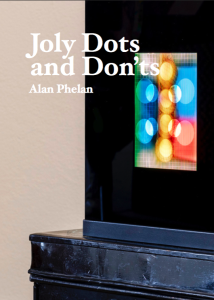
Joly Dots and Don’ts,
Alan Phelan
Published by PhotoIreland
Edition of 200
Softcover
32 pages
148 x 210 mm
€6.00
Tax included.
Shipping calculated at checkout.
DESCRIPTION
Alan Phelan has been working with the Joly screen process since 2018, one of the first stable colour photography methods that was invented by Trinity College Dublin physics professor John Joly in the 1880s. The ‘additive’ or ‘separate’ process uses a red, green, and blue striped screen to filter light on exposure and display to make colour from light not chemistry.
The content of the images is broad as Phelan wants to create a visual history for the process that it never had a chance to have as it was abandoned early on.
This selection draws on several projects — flower photographs that reference floral paintings and arrangements over five centuries; self-portraits that connect to queer photography history in performing identities; and ‘dot’ photographs which exploit the layered process, leaving dot gaps in the stripes and adding visual complexity with coloured paper and re-photographed found images.
For those that are not familiar with the project, TLP Editions is an ongoing collection, produced and designed by PhotoIreland, that presents work by contemporary artists in the form of uncomplicated publications. These are available through The Library Project in-store and online. All and any funds generated by the project go to producing more copies of the publications, ensuring we can keep promoting the artists and practices represented. These editions are regularly showcased and donated to international events and festivals, such as the Icelandic Photography Festival recently. In addition, TLP Editions also grace some important shelves and collections, including that of the Hasselblad Foundation Library and the Martin Parr Foundation.
You can find a list of all the TLP Editions here.
PhotoIreland is kindly supported by the Arts Council of Ireland to develop support projects such as the TLP Editions.
JOLY SCREEN PHOTOGRAPHS
FLEURS TARABISCOTÉ: ALAN PHELAN
This show opened 8 July and presents a new selection of flower photographs. Most will be shown for the first time in Dublin and several have never been shown at all before.
Check the Molesworth Gallery website for details.
An online publication has been produced with Oonagh Young at Design HQ which will be available shortly from the Solstice Arts Centre website.
On Thursday 4 February 2021 Ruth Carroll, curator from the RHA, Dublin will be in discussion with me at the Centre Culturel Irlandais, Paris via Zoom at 8pm Paris/ 7pm Ireland – reserve a place here to get the link
This exhibition brings together a selection of Alan Phelan’s unique Joly Screen Process photographs and a new large scale music video work about the inventor of this forgotten colour photography process which was abandoned from use over 100 years ago.
Over the past three years Phelan has worked on reviving the process, invented in the 1890s in Dublin by John Joly, a physicist and geology professor from Trinity College, Dublin.
Phelan’s ambition is to create a visual history for the process that it never had. To do this he uses art and historical references spanning over 500 years. The work presents a “counterfactual temporality”, to create a longer potential history for photography.
The photographs comprise of two parts – the sheet film from a large format camera and a colour screen, printed onto clear sheet. The Joly process is not a chemical dye coupler or inkjet but instead filters light to create colour, on exposure and then on display. The screen is made up of red, green and blue stripes, giving the photographs a very distinct appearance. The small images have the intensity of painted miniatures, illuminated by LED panels, slowing down the viewing of a photograph as well as allowing for a unique colour shift that happens on display.
Phelan also engages different installation devices on walls, windows and lighting to reference the process as well as narratives from a wider art history of painting and sculpture. He frequently collaborates with others in making work and in this case has worked with members of the Dunboyne Flower & Garden Club in making the floral images for this exhibition. For Phelan this is an opportunity to expand his interest in participatory practices – art making that involves working with others to expand the notion of authorship into a shared activity one where meaning remains unfixed and creating agency as well as new knowledge in the process.
Similarly he has worked with a variety of talented artists and musicians for the video who include Elaine Hoey, James Kelly, Ian McInerney, The Late David Turpin, and Louis Haugh. The video brings the analogue stripes of the Joly Screen into the digital age with audio-responsive animations which overlay a troubled biographical narrative about John Joly and his collaborator Henry Dixon. Typical of Phelan the story presented is a fusion of references coming from texts by Samuel Beckett and Jean Genet and functioning outside of adaptation or appropriation to “re-narrativise” instead and create a new or different story history.
The photographs in Folly & Diction are arranged in sequences that mix floral, self-portraits and objects, with titles acknowledging source artists and related historical events. The show title embeds Joly & Dixon into this speculative history by homonym, while acknowledging the possible humour in these probable revised histories and queer re-reading of photography.
Public Events
Wednesday 4th March, 6.30pm: Love: first, second, third
In this live performance, two actors will read, critique and deconstruct two of the literary texts by Samuel Beckett and Jean Genet that are referenced in Phelan’s video work. The event explores fan fiction which switches genders and the sexuality of characters from original texts as Phelan has done in his film. With a live re reading of the source material the actors will interact with live video projection, offering an additional commentary, providing different insights into how all three texts can, and have been interpreted. Booking is essential for this event.
Saturday 21 March, 2pm: A Dance Response by Dublin Youth Dance Company
All welcome, booking not required. Over the course of Phelan’s exhibition, Dublin Youth Dance Company (DYDC) will be developing a dance performance in response to the work in the show. This response will be presented to the public in the gallery on Saturday 21 March at 2pm.
Dublin Youth Dance Company (DYDC) is Ireland’s premiere contemporary youth-dance group that continuously strives for excellence and high standards. Their main aim is to offer talented young dancers the opportunity to participate in the creation, production and performance of contemporary dance works to the highest-level of expertise. DYDC also presents the annual Irish Youth Dance Festival with International Dance Residencies, master classes and stage performances at Draíocht Arts Centre, 27 & 28 June and Pavilion Theatre, 4 July.
www.dublinyouthdance.com

Artist Bio
Alan Phelan, born 1968, is an artist based in Dublin whose practice began in photography and has extended into many different media and mediums with a focus on interpretation, language and collaboration. He studied at Dublin City University and Rochester Institute of Technology, New York. Recent exhibitions and projects include The Dock, Carrick-on- Shannon, Company of Others, CCA, Derry, TBG+S Atrium, The LAB, Dublin, and Glucksman Gallery, Cork. Our Kind, commissioned by Dublin City Gallery The Hugh Lane for 2016/1916 was also screened in Oslo, Bergen, Derry, Belfast and Carlow where it won the Hotron Éigse Art Prize. Internationally he has shown at Dada Post, Berlin, Loop, Barcelona, Videonale.15 Bonn Kunstmuseum, Detroit Stockholm, Bozar, Brussels, Treignac Projet France, Eastlink Gallery, Shanghai, Oksasenkatu 11, Helsinki, Mina Dresden Gallery, San Francisco, Galería Del Infinito Arte, Buenos Aires, ŠKUC, Ljubljana, SKC Gallery, Belgrade, Whitney Museum of American Art, New York.
His solo exhibition for IMMA in 2009 also had versions at Chapter, Cardiff and LCGA, Limerick. Public art commissions include works for Dublin City Council, Dublin South County Council, St Michael’s House Special National School Raheny and the Dept of Communications. For studies in the USA he received a Fulbright Scholarship and John F Kennedy Fund Scholarship and has received several awards from The Arts Council, Culture Ireland, and Creative Ireland. His work is included in the collections of the IMMA, TCD, LCGA, The National Self-Portrait Collection, the OPW, and several private collections. He is currently the NCAD School of Fine Art Artist in Residence for 2019-20.
Image: Alan Phelan, Carol Sawyer as Natalie Brettschneider as Leaf as Me, 1986 when Ray was really Miller, 2019, Joly Screen photograph: toned gelatin silver sheet film (reverse processed), duraclear c-print screen, acrylic panels, LED panel, MDF support, electrics, archival paper tape, insulation tape, Image courtesy the artist.
Image: Alan Phelan, Jean-Baptiste Belin de Fontenay 1705, when Mirabell and Millamant were in double abundance, 2019, Joly Screen photograph: toned gelatin silver sheet film (reverse processed), duraclear c-print screen, acrylic panels, LED panel, MDF support, electrics, archival paper tape, insulation tape; courtesy the artist.
Temple Bar Gallery + Studios presents Dublin Art Book Fair 2019 (DABF), the only art book fair in Ireland, now taking place over ten days from 21st November to 1st December 2019. DABF is sponsored by Henry J Lyons and supported by Dublin UNESCO City of Literature.
The ninth edition of Dublin Art Book Fair platforms creative and cutting-edge publishers, big and small, Irish and international, and is a centre for the contemporary artist book. Browse a vibrant mix of books on art, architecture, visual culture and select fiction, enjoy a coffee and engage in a free programme of talks, tours, workshops and discussions in a relaxed and stimulating environment.
This year DABF is guest curated by Dr Kathleen James-Chakraborty, Professor of Art History at University College Dublin. In a series of talks, workshops, open studios, book launches and panel discussions, the theme, Art & Architecture: Learning from the Bauhaus will consider how the twentieth-century’s most innovative and influential school of art, craft, design and architecture continues to influence a hundred years on. Contributors include Martino Stierli (Chief Curator of Architecture and Design, Museum of Modern Art New York); Grant Watson (London based independent curator and researcher) and Kerry Meakin (Programme Chair, Visual Merchandising & Display, TU Dublin). There will be an interdisciplinary panel discussion featuring visual artists, architects and designers on the influence of Bauhaus on their own practice; a series of artist-led workshops taking inspiration from Bauhaus ideas, including colour theory, printmaking and wallpaper design, alongside open studios with artists at Temple Bar Gallery + Studios.
Over the opening weekend, DABF presents Publication Scaffold a wide-ranging and digressive series of events, performances, installations and discussions hosted by artists Sean Lynch, Michele Horrigan and curator Jo Melvin. Highlights include the launch of John Hutchinson’s new publication, ‘Countercultures, Communities and Indra’s Net’ and a debut performance by Ruth Clinton and Niamh Moriarty. Emanuele De Donno will reveal the inner workings of Viaindustriae, an expansive publishing and research initiative based in Foligno, Italy, while John Carson’s sprawling psychogeographic artwork, Evening Echoes, presented at Temple Bar Gallery + Studios back in 1995, will be reprised.
A big feature of Dublin Art Book Fair is the artist book, offering an affordable way to collect art while also being a great way to give a gift of art. The Artist Book Section at DABF will feature an array of artists’ books from all areas of contemporary art and design, published and independently made, as well as four specially commissioned artist books by Chloe Brenan, Catriona Leahy, Richard Proffitt and Tamsin Snow. Recent artists’ publications in the Artist Book Section will include Dragana Jurišić & Paula Meehan’s ‘Museum’, Susan MacWilliam’s ‘Modern Experiments’ and Catriona Leahy’s ‘The Aesthetics of Disappearance’.
Book launches at DABF will include TBG+S studio artist Niamh O’Malley’s publication based on her recent solo exhibition at RHA Dublin, with readings by Niamh O’Malley and writer, Claire-Louise Bennett, whom she commissioned to write for her book. Artist, Orla Barry’s new publication ‘Shaved Rapunzel, Scheherazade and the Shearling Ram from Arcady’, based on her acclaimed touring exhibition ‘Breaking Rainbows’ shown at TBG+S in 2016, will be launched at DABF.
#DABF19
35 Artists At Large experienced through screen-printed posters & letters (“Orphans”) & 6 collaborative zines.
Bassam Al-Sabah, Ella Bertilsson & Ulla Juske, Susan Buttner, Dorje De Burgh, Stephen Dunne, *Lily Cahill & David Fagan, Child Naming Ceremony, *Jessica Conway & Catherine Barragry, *Laura Fitzgerald & Katharine Barrington, Damien Flood, Michelle Hall, Austin Hearne, Ann Maria Healy, Sinead Keogh, Mollie Anna King, *Silvia Maglioni & Graeme Thompson aka Terminal Beach (invited by Katherine Waugh), Jonathan Mayhew, Angela McDonagh, Glenn McQuaid, Celina Muldoon, Frances O’Dwyer, *Alan Phelan & Philipp Gufler, Liliane Puthod, Chris Steenson, Frank Wasser, *Lee Welch & Paul Hallahan,
*Collaborative zines
Kindly supported by the Arts Council through the Visual Arts Project Award.
Date(s) – 21/11/2019 – 29/11/2019
12:00 pm – 6:00 pm
Location
Pallas Projects/Studios
Website
http://www.pallasprojects.org/
Email
eve@pallasprojects.org
16 November – 04 January
Alan Phelan has been working for the past three years on reviving the Joly Screen process, a forgotten colour photography process invented in the 1890s in Dublin by John Joly, a physics professor from Trinity College.
This exhibition marks the first major exhibition of this new body of work. The photographs are small 4×5 sheet film sized images as they comprise of the sheet film from a large format camera and a colour screen. The Joly process is not a chemical process but instead filters light on exposure and display to create colour. The screen is made up of red, green and blue stripes which Phelan then engages as installation devices on walls and windows to reference the process and a wider art history of installation. The small images have the intensity of painted miniatures, illuminated by LED panels, slowing down the viewing of a photograph as well as allowing for a unique colour shift that happens on display.
The images have nostalgic feel given muted colours and the content of this selection of work which reference historic flower paintings made in collaboration with Dunboyne Flower and Garden Club*. For Phelan this is an opportunity to expand his interest in participatory practices, art making that involves working with others to expand the notion of authorship into a shared activity, one that remains unfixed and creating agency as well as new knowledge in the process.
The above image references the work of Spanish painter Juan van der Hamen’s work from the 1620s.
*Alan Phelan and Dunboyne Flower and Garden Club were recipients of Meath County Council Cultural Services Creative Award 2019. This award is supported by the Meath County Council Creative Ireland Programme.
Photos by Paul McCarthy
Aila Harryson Lorigan, Alan Phelan, Alisha Doody, Andy Osborn, Anita McCarthy, Aoife Herrity, Audrey Hendy, Barbara Kenneally, Becks Butler, Billy Kenrick, Brian Giles, Brian McIlvenny, Brian Teeling, Bronagh Lee, Bronwyn Andrews, Bryan Hogan, CANVAZ, Caoimhe Dalton, Ciaran Meister, Claire McCluskey, Claire Prouvost, Clare Lynch, Clare Lyons, Clodagh O’Leary, Colin Jones, Conor McMahon, Conor Nolan, Crona Gallagher, David Begley, David J Moore, David McGinn, Dermot Ryan, Dorje de Burgh, Dorota Borowa, Eimearjean McCormack, Eimhinn Farrell, Elise Fisher, Elizabeth O’Shaughnessy, Ellie Berry, Els Borghart, Emma O’Hara, Freja Blomstrand, Gabrielle Bowe, Gary Byrne, George Voronov, Gintaras Varnagys, Giorgia Graf, Giulia Berto, Grainne Murphy, Helena Gouveia Monteiro, Holly Anna Furey, Hugh Quigley, Iryna Baklan, Izzy Rose Grange, Jane Cummins, Jason Minsky, Jill Quigley, Jo Kimmins, Joanne Betty Conlon, Joe Marner, John Busher, Juliana Falanghe, Juliette Liautaud, Kelsey Lennon, Kimberly Goes, Kurb Junki, Laura McMorrow, Lorcan Cassidy, Luke Reidy, Madison Donohue, Margaret McLoughlin, Margo McNulty, Marian Balfe, Martina Cleary, Mary Keane, Mary O’Connor, Maureen Burke, Meabh Joyce, Megan Doherty, Monolith, Muntsa Molina, Myles Shelly, Neil Dunne, Neil J. Smyth, Niamh Coffey, Niamh Gillespie, Norah Brennan, Pauline Rowan, Peter Bjoerk, Rafal Krol, Ramona Farrelly, Rebecca Phelan, RGKSKSRG, Ria Czerniak, Róisín McGannon, Róisín White, Ruth Connolly, Ruth McLoughlin, Sarah Bracken Soper, Sarah Usher, Sean O’Donnell, Simon Bates, Stasele Jakunskaite, Ste Murray, Stephane Bruchet, Steven Nestor, Vaida Varnagiene, Vesna Gasparic, Wally Cassidy, and Yuri Kawakami.
Location
The Library Project
4 Temple Bar Street, D02 YK53, Dublin, Ireland.
Launch
2pm Saturday 2nd November 2019
Running
Until 2nd December 2019
HALFTONE is an initiative by PhotoIreland, hosted every year at The Library Project. Running for a month in this 5th edition, the fair brings together a large selection of works by established and emerging artists, showcasing Ireland’s exciting Art scene.
HALFTONE is the ideal place where to get to grips with a diversity of printing techniques while discovering new work for your collection or finding an excellent present. It is a great opportunity to purchase fantastic artworks at enviable prices!
Image: I Can’t Hear You, 2018
Gelatin silver sheet film (reverse processed), duraclear c-print
25 x 26 cm. in a Lightbox
Edition of 1
“Phelan has been working for the past 3 years on reviving a forgotten colour photography process invented in the 1890s in Dublin. John Joly, a professor from TCD invented a process that proved full colour could be made from combinations of red, green and blue light. The resulting photograph is comprised of two parts – black and white sheet film and a colour screen made from red, green and blue stripes. This is not a chemical process but instead filters light on exposure and display to create colour. This image is from a series of self-portraits and formed part of an installation at The Lab earlier this year. Phelan will have a series of exhibitions in 2020 which will show many more variations of these photographs at the RHA, Void, Solstice and CCI Paris.
About the Artist
Alan Phelan studied at Dublin City University and Rochester Institute of Technology, New York. Exhibitions include: 2019 TBG+S Atrium, The LAB, Dublin, Glucksman Gallery, Cork; 2018: Dada Post, Berlin; 2017: Loop, Barcelona; 2016: Dublin City Gallery The Hugh Lane, EVA International, Limerick, NSK Folk Biennale; 2015: GDA commission, Videonale.15, Fragments, IMMA; 2014: Golden Thread Gallery, Belfast, Detroit Stockholm; 2013: Treignac Projet, Oonagh Young Gallery, Dublin; TBG+S; Bozar, Brussels; 2012: Eastlink Gallery, Shanghai; 2011: Oksasenkatu 11, Helsinki; Mina Dresden Gallery, San Francisco; 2010: Galería Del Infinito Arte, Buenos Aires; 2009 Fragile Absolutes, IMMA, Dublin and Chapter, Cardiff; EV+A, Limerick; 2008: Solstice Arts Centre, Navan; 2007 Feinkost, Berlin; mother’s tankstation, Dublin; 2006: ŠKUC, Ljubljana; SKC Gallery, Belgrade; The Lab, Dublin; 2004: Whitney Museum of American Art, New York.
His work is included in the collections of the Irish Museum of Modern Art, Trinity College Dublin, Limerick City Gallery of Art, The National Self-Portrait Collection, the Office of Public Works, Dublin City Council and several private collections.”
alanphelan.com
CCA is pleased to present the first iteration of The Company of Others, an open research project undertaken with artists David Beattie and Alan Phelan and the Centre for Experimental Archaeology and Material Culture (CEAMC) in University College Dublin (UCD).
The Company of Others is a project that concerns relationships between colonialism, capitalism, and material culture. It takes its starting point from Derry’s history – of the plantation of the city and surrounding area by the commercial guilds of London – but from there speaks outwardly to other contexts and time-frames. The project is especially interested in the material practices of the livery companies that formed the foundations of British colonialism in Derry.
The 12 guilds that were given control over Derry and the regions adjacent were the Mercers, Grocers, Drapers, Fishmongers, Goldsmiths, Skinners, Merchant Tailors, Haberdashers, Salters, Ironmongers, Vintners, and Clothworkers. The smaller guilds that joined them included the Cordwainers, Dyers, Scriveners, Upholders, Wax Chandlers, Tallow Chandlers, Broderers, Founders, Pewterers, and Fletchers. The names of these skills and trades evoke a set of practices, materials and processes that the artists have been invited to research in this public event.
David Beattie
For The Company of Others Beattie has worked with the UCD School of Experimental Archaeology to explore the process of tablet weaving as a means to discuss technological change and a current shift towards an automated, machine focused society. Using the Guilds of Derry and the Weavers in particular as a starting point, Beattie’s research is drawing parallels between the effect of the Jacquard loom on the textile industry and current implications of artificial intelligence on future human labour. In 1801 Joseph Marie Jacquard invented a power loom that could base its weave upon a pattern automatically read from punched wooden cards. This system became the basis for many automated and computational machines in the late 19th and early 20th centuries, leading to the creation of IBM and the first computers of the mid 20th century.
In the current digital computing age, image recognition and deep learning is perhaps of greatest significance. Machines are being taught to see, think behave as humans do, recognising images, objects, and emotions according to their databases. The goal is to achieve a trans-human state that can replicate or even improve on human behaviour, evolving to co-exist in virtual, mixed and augmented worlds.
Beattie will present the results of this research on the walls outside CCA alongside a demonstration of tablet weaving by UCD researcher Bridgit Lee on 28September from 2:30–4:30pm All welcome, human and machine.
Alan Phelan
Alan Phelan references Roger Casement and the coffee bean variety he acquired in Congo, called Liberica, now held in the collection of the National Botanic Gardens, Dublin. Liberica is also the name of a café chain in Indonesia where the bean replaced the diseased local arabica. Phelan hand draws the company logo to re-brand and up-cycle used paper coffee cups. The project develops in this new iteration by combining other unrelated cultural references to explore a different kind of operational sequence common to anthropological discourse.
Related to histories of the Guilds and the Company of Grocers, Phelan’s research initiates a discussion about the interconnections of global capitalism, disposable consumerism, branding, cultural appropriation, empire, nationalism and freedom.
Working with the potter Brian Magee to create branded Liberica ‘kulhar’, Phelan will stage a demonstration of “off the hump” wheel-throwing of these disposable clay cups from 2-4pm. Specially imported Liberica coffee will be served and hand-drawn up-cycled cups will be available for sale or exchange.
Company of Others takes place as part of the Walled City – 400 Years programme of events, funded by Derry City and Strabane District Council.

The ninth BF Artist Film Festival is premiering at The Gregson Cinema in collaboration with GRAFT Lancaster!
We will be screening:
A to B by Jack Lewdjaw
The Common Instrument II – IV by Thomas Goddard
Dialogue with the Previous by Veronika Čechmánková
Cheeseballs in the Era of…by Lindsay Garcia
Still Lives by Elli Vuorinen
makin glove by Lil Smith
a warm glass of milk by Heidi Elyce Cooper
Octopuses are actually space aliens whose frozen eggs first came to Earth aboard an icy meteor by Jo Pester
Benjamin’s Orchid by Wilf Speller
PART II
you took the words right out of my mouth by Jessica Jordan-Wrench
Family crockery (whiteness) by Amelia Johannes
My Applause by Weiye Wang
My Studio Tour vs TOILET GRAFFITI by Josh Vyrtz
You should take more care by Sarah Jenkins
Wolves From Above by Demelza Kooij
Pantone 2685 by Alan Phelan
Curtains by Alfie Dwyer
Clout by Jake Francis
GRAFT LANCASTER promotes contemporary art, supports emerging artists and develops creative learning opportunities with schools and the community. More information: https://graftlancaster.com/
19 July — 07 September 2019
Alan Phelan has been working for the past three years on reviving the Joly Screen process, a forgotten colour photography process invented in the 1890s in Dublin. The Joly Screen image on show is from this new body of work which Phelan has recently begun to exhibit. The photograph comprises two parts – black and white sheet film and a colour screen made from red, green and blue (RGB) stripes. This is not a chemical process but instead filters light on exposure and display to create colour. Phelan’s practice is often site responsive and, for this installation in Temple Bar Gallery + Studios’ Atrium, the windows are striped in RGB to turn the space into a proxy camera body as well as creating a darkened space to view the internal window as a light box. The wall text is a lyric from an upcoming film project by Phelan, which has roots in the poetry of Jean Genet and texts by Samuel Beckett, connecting this installation to a larger body of work.
Alan Phelan holds a Three Year Membership Studio at Temple Bar Gallery + Studios (2016-2019). Recent exhibitions include Lewis Glucksman Gallery, Cork; The Lab, Dublin; and The Hugh Lane, Dublin City Gallery. Forthcoming exhibitions include The RHA, Dublin; Void, Derry, and CCI Paris. He received an Arts Council visual arts bursary in 2017 and the 2019 Creative Award from Meath County Cultural Services funded by Creative Ireland, working with the Dunboyne Flower and Garden Club, which will result in an exhibition at The Dock, Carrick-on-Shannon in November.
Temple Bar Gallery + Studios’ Atrium connects the public gallery to the individual artists’ private working spaces. Current TBG+S studio artists are invited to use the Atrium to test experimental work or exhibit ideas and artworks in progress.
Dervla Baker, Lian Bell, Lisa Butterly & Lisa McCormack, David Creedon, Adrian Duncan, Cáit Fahey, John Halpin, Roseanne Lynch, Tom Molloy, Vukasin Nedeljkovic / Asylum Archive, Ailbhe Ní Bhriain, Miriam O’Connor, James Parkin, Alan Phelan, Amelia Stein, Mhairi Sutherland
13 April – 30 June 2019
Curated by Chris Clarke and Fiona Kearney, The Parted Veil: Commemoration in photographic practices is an exhibition of sixteen Irish artists who have used the photographic image to consider ideas of remembrance and celebration, and especially to reflect how intimate experiences express the wider events shaping our contemporary world.
A dedicated publication is being developed to mark the exhibition and will feature images from the exhibition, a contextual essay by Dr. Adam Hanna and poems from invited Irish writers Ailbhe Darcy, Vona Groarke, Doireann Ní Ghríofa, Billy Ramsell, and Leanne O’Sullivan
http://www.glucksman.org/exhibitions/the-parted-veil
Anne Maree Barry, Declan Clarke, Alan Phelan, Clíodhna Timoney, The Brian McMahon Archive (Brand New Retro)
March 22 – May 12 2019
The LAB Gallery is pleased to present the Last Great Album of the Decade in association with Musictown.
The exhibition is co-curated by Pádraic E Moore and Sheena Barrett and features new work by Anne Maree Barry, Declan Clarke, Alan Phelan and Cliodhna Timoney. The title is both suitably brash, claiming greatness, and mournful, in suggesting that it can’t be surpassed.
This exhibition seeks to celebrate the musical relic and souvenirs of the subculture, taking in gigs in the 90s, a selection of zines from Brand New Retro, the Dublin rave scene in the early 2000s, the demise of rural nightclubs and journeys from early photographic experiments through to the potential backdrop for a new music video.
Stepping into the Music Library at the Central Library in the Ilac Centre visitors can skip through genres via the biographies of musicians, sheet music, vinyl and cds and we’ve also planted copies of Eoin Devereux’s hidden track, along with Audrey Walshe’s botanical response to the show.
In partnership with Musictown, we are also running two very special events, a screen-writing workshop for teenagers with Anne Maree Barry in the Music Library and an historial music tour of the city with Donal Fallon. Bookings through Eventbrite.
In addition to Dublin City Council this exhibition has been supported by the Arts Council of Ireland, Inspirational Arts and Oonagh Young Gallery. We would also like to thank Rebecca O’Dwyer, Mark Clare, Liam O’Callaghan, Leagues O’ Toole and Amy Nix (MusicTown) and the Gallery of Photography.
Essay by Pádraic E Moore and Sheena Barrett
The term ‘album’ was adopted into English in the seventeenth century from the Latin phrase album amicorum (meaning ‘album of friends’) to describe a book that collected autographs, drawings or poems. At the beginning of the twentieth century, the term became shorthand for the phonograph record; in the years that followed, it also came to refer to a wave of new formats that arrived in quick succession: cartridge, cassette, compact disc, and the (relatively short lived) MiniDisc. From the sixties onwards, the album became the supreme mode of musical expression, the place where artists pushed boundaries, took risks, and evolved new genres. Today, musicians are still doing this, of course, but the way we listen to recorded music has drastically changed. As one consequence of online streaming, albums are being increasingly replaced by private, personalised playlists. In this, the coherence or intended sequence of an album is undermined, along with, quite possibly, the communal potential of the music itself. Yet while the declining centrality of the album as art form and commodity has changed how music is collected and consumed, there is no doubt that recorded music is as capable as ever of raising consciousness – of taking us out of – and beyond – ourselves, and bringing us together. And there are still legions of us listening to new albums, on repeat, for days on end.
If this exhibition was an album, it would be heterogeneous and epically sprawling: a four-sided affair, maybe something like Prince’s Sign ‘O’ The Times or The Orb’s Adventures Beyond The Ultraworld, featuring a hallucinatory sleeve that you and your friends would stay up all night studying. Obviously, this exhibition – is not – an album; but several of the elements from which it is comprised, such as the hidden track — here taking the form of an essay by the sociologist and writer Eoin Devereux – are conceived in an enthusiastic nod to the format. Like all the best albums, the exhibition is founded on the implicit conviction that music can be a supreme connector, creating hives of likeminded folk and offering the chance of escape from an antagonistic society. At its heart, the project is a testament to musical culture as an unparalleled catalyst for social exchange.
True believers, we celebrate the musical relic and souvenirs of the subculture. Declan Clarke recalls gigs he attended in Dublin in the early nineties; here, he shows an array of ticket stubs and t-shirts collected all those years ago. Of course, these objects hold personal significance for the artist. Yet from a social history perspective, they also represent a seminal moment in the transition of youth culture, at which popular musical taste moved rapidly from indie rock into electronica, and rave scenes emerged. Photos of Clarke taken surreptitiously by his late father in 1991 show the artist surrounded by his posters and cassettes, suggesting how the adolescent’s journey of discovery for belonging in musical worlds can provide a lifelong source of enthusiasm. Alongside Clarke’s paraphernalia, a selection of zines from the Brian McMahon Archive (Brand New Retro) offers insight into how the range of music-related printed matter produced and disseminated offered a focus for communal exchange. While the production quality of these relics varies hugely, it is clear that the determination and desire to contribute to a dialogue and to express enthusiasm is much more urgent than any questions of technique or finish. The real point of these objects was to pass them on in spirited conversion attempts, or to argue about them with friends.
Although different in many ways, the potential and the power of the DIY ethic is also discernible in a series of photographs taken by Anne Maree Barry. These images of underground self-organised parties that took place in the summer of 2003 show a large group of young people sprawled over what might be an island, just as first light breaks. Such parties emerged from a culture of self-organisation and self-sufficiency, with an emphasis, as with their rave precursors, upon inclusion and togetherness facilitated (primarily) through music. While the work could be described as documentary in nature, it should be noted that Barry, as opposed to a voyeur, was an active participant in these events. Looking at them now, it’s striking that no one is using a phone. The images take on a nostalgic tinge, accentuated by the image quality, which conveys a documentary realism in comparison to the filtered smartphone lens used to share experiences with a community not present via Instagram. The parties captured in these photos were relatively rare in a city like Dublin. Indeed, as the city recovers economically and becomes less affordable, such gatherings are becoming even rarer still. Regulation and legislation along with changing land use have put increasing pressure on the viability of nightlife and club culture. The critical nature of this situation has led to the Give Us the Night campaign, who are lobbying to have the value of nightlife, economically and socially, recognised and to counter more conservative leadership that views nightlife and club culture as insignificant or even deviant.
While the aforementioned artists focus on the material remnants and the social milieu that forms around music, others respond to and ‘inhabit’ music much more formally, making work concerned with characteristics aligned with its production: Alan Phelan’s visually striking installation entitled A Joly Screen, the background, for example, made from material usually used in backdrops for photo shoots. In this instance, the RGB ‘curtain’ has been conceived as a backdrop for a music video. Alongside the lastolite stripes (that partially obscure the interior from the exterior) a mattress and some other ‘props’ charge the installation with narrative possibility. As with much of Phelan’s earlier body of work, A Joly Screen, the background, is informed directly by research into historical narratives, and the desire to interrogate the official aspects of these stories[1]. In creating this speculative music video set, he aims to create a site of possibility and potential. Ultimately, this demonstrates his interest in the provisional nature of an artwork as never quite complete, never fully resolved, just about there but not fully. A piece of electronic music composed to accompany Phelan’s mise en scène — something like the excerpt of a soundtrack to an as-yet unmade film — will be presented on the exhibition’s opening night.
A new body of sculptures by Cliodhna Timoney refers to several nightclubs in her hometown of Letterkenny in County Donegal, many of which flourished in the mid to late nineties. Now, some of the clubs are defunct, while others are just about holding on, in a state of clear dilapidation. The titles of Timoney’s assemblages — such as The Golden Grill, The Pulse and Voodoo – are taken directly from the names of these maligned venues. Much like the broader county itself, they have been left behind in the wake of the latest crash, or rendered unviable for the simple lack of young people still living in the area. Her sculptural accumulations are both an homage and formal interpretation of these environments of music and hedonism, where people go to lose themselves and engage in dance-floor catharsis. Scattered throughout the gallery, Timoney’s variegated assemblages suggest the detritus that remains in the aftermath of the party: when the lights are brought up cruelly to mark the night’s end, dazzling us into blindness.
Beyond the original desire to explore collections of musical ephemera, along with artists interested in using music as a referent, much of the thinking around this project has been informed by the writing of cultural theorist Mark Fisher. While his scathing if accurate analysis of contemporary society is somewhat dispiriting, his writing is always balanced by enthusiasm. Nowhere is this more discernible than in his intense, and at times somewhat unlikely, appreciation of popular music. In particular, he was fascinated by popular music’s capacity for “nihilation; the producing of new potentials through the negation of what already exists”[2]. A key concept propagated by Fisher is what he described as ‘popular modernism,’ referring to a kind of culture — often found in music — that merged experimental elements with mainstream modes of production and dissemination. Fisher’s writing undermined the delineation of culture into categories of ‘authentic’ and ‘popular’ and implied that pop culture can also function as a critique, – as opposed to affirmation – of the society from which it emerges.
A similar desire to emphasise the importance of popular music was conveyed by Dan Graham in his seminal video essay Rock My Religion from 1985. At that time, when convergences between visual art and music were reaching unprecedented synergistic peaks, Graham’s essay sought to examine and underscore the importance of certain musical genres of the preceding decade. Proposing a lineage of rock music from the sixties back to certain forms of ritualistic practice and religious worship such as that of the (dancing) Shakers and Quakers, the essay shows popular rock music’s deep capacity for facilitating certain forms of enlightenment and egalitarian togetherness. As he neatly puts it in the essay’s closing lines: “if art is only a business, as [Andy) Warhol suggests, then music expresses a more communal, transcendental emotion which art now denies”. In this sentiment, Rock My Religion is a crucial touchstone for The Last Great Album of the Decade. Much like the film, this exhibition revels in those sacral aspects of popular music that that have (perhaps necessarily) been discarded or denied from the sphere of visual art. It makes room to consider, quite seriously, the profound devotion of the fan, the surrender to cultish following, the fetishistic interest in memorabilia, the communality of the sweaty fray, and perhaps, most importantly, the desire to get lost in “The Thrill of it All”[3].
The Last Great Album of the Decade is co-curated by Pádraic E. Moore (independent curator) and Sheena Barrett (Assistant Arts Officer at Dublin City Council/The LAB Gallery Curator).
[1] This work is informed explicitly by Phelan’s ongoing research into John Joly (1857–1933) one of Ireland’s most eminent scientists of the late nineteenth and early twentieth centuries who made important discoveries in physics, geology and photography. Phelan’s work references the ‘Joly colour process’, one of the first practical methods for colour photography that entailed the use of glass photographic plates with fine vertical red, green and blue lines printed upon them.
[2] k-punk: The Collected and Unpublished Writings of Mark Fisher (2004-2016) edited by Darren Ambrose with Simon Reynolds. Repeater Books. 2018. p.321
[3] The Thrill of It All is a single by Roxy Music featured on their 1974 album Country Life.
Dublin Art Book Fair, Ireland’s only art book fair, takes place at Temple Bar Gallery + Studios (TBG+S) from 22nd to 29th November 2018.
An established feature of the annual gallery programme at TBG+S, the 8th edition of the Fair is sponsored by Henry J Lyons, supported by Dublin City of Literature. Dublin Art Book Fair 2018 is guest curated by architectural and cultural historian, Dr. Ellen Rowley.
The theme Art and Architecture, this year, sees a special focus on Uncovering Libraries and Collections, highlighting the importance of libraries in our lives. Showcasing over fifty leading Irish and international publishers and small independent publishers, the Fair will include books and publications on art, architecture, design, visual culture and related fields as well as limited edition and rare artist and architects’ books.
A new feature of Dublin Art Book Fair is the Children’s Section, made possible by support from the Arts Council Ireland’s Engaging with Architecture Scheme. The Children’s Section will include an eight-week educational programme engaging pupils of the Gaelscoil, Colaiste Mhuire, and involving the Irish Architectural Archive. Artists Tanad Williams and Andreas Kindler von Knobloch will collaborate with architect Tom O’Brien to design and build the Children’s Section for the Fair.
An expansive programme of free events, curated by Dr. Ellen Rowley, at TBG+S and throughout the city, will transport you to the supposed origin of the library and guide you into some of Dublin’s leading libraries and little-known collections. The jam-packed schedule of site-specific performances, workshops, walking tours, readings, children’s activities, panel discussions and illustrated lectures combined with a pop-up café, a welcoming social atmosphere and of course, the celebration of art books, means you’re sure to find something to pique your interest in the heart of Temple Bar.
Click here for the full programme of events: http://www.templebargallery.com/events
Dublin City Council Public Art Programme is pleased to announce that Alan Phelan has been selected as the artist to carry out the Kevin’s Street Public Library Public Art Commission.
Following consultation with Dublin City Council Libraries Service and the architect leading the renovation of the library, it was decided that a permanent visual artwork be commissioned to be displayed within the Kevin Street library’s interior. The artist was selected through limited competition with nominations for a long-list from two external visual arts curators and the Arts Office. Alan Phelan’s proposal was selected by the final selection panel which included representatives of the Libraries and Archive Services, City Architects, Arts Office, Public Art Manager and an external art expert. His proposal was selected for the excellence of the artwork, its direct connection to the library and an interest in working with library staff in the final development of the artwork.
Curated by Sheena Malone:
Artists: Zara Alexandrova, Ro Caminal, Laura Carvalho, Declan Clarke, Zoran Georgiev, Eddie Kenrick, Stephan Maier, Michael Merkel, Alan Phelan, Kathy Tynan, Sadie Weis
ERÖFFNUNG: 7:00pm, June 16th, 2018. Exhibition continues until: July 6th, 2018
Trophy Hunters takes on the theme of sports in conjunction with the 2018 FIFA World Cup.
Dada post is located in the Berlin-Reinickendorf district, in the former König Smoked Fish Factory complex. The one hundred year-old business was transformed into exhibition, performance, and studio spaces for artists. The gallery itself comprises two major spaces. The adjacent out- and indoor sites have also been designated for exhibition purposes, including Gallery Space 3, also known as The cooler. It also inlcudes various storage and exhibition bays, a resident artist apartment and studio, a small bar and beer garden, 3 artist studios, and a house, all disposed around a triangular courtyard with a 1936 bunker at it’s center.
The renovation and redesign of the complex took both its history and the demands of contemporary art into consideration. The facility is easily recognizable by its large smokestacks, which recall the slants of the gallery logo, and have been retained as a reference to the original commercial use of the site.
With its themes of art and architecture, this year’s Henry J Lyons-sponsored Dublin Art Book Fair will take place at Dublin’s Temple Bar Gallery and Studios, with other events at the Irish Architecture Foundation, Tenement Museum and the National Gallery of Ireland, across November 23-26.
Bridging the distinct realms of art and architecture in order to engage diverse audiences, a curated programme of talks, tours, workshops, an artist commission and a film screening will traverse contemporary art, architecture, books, design, film, the city and its material histories.
Launched at 6pm on Thursday, November 23, highlights of this year’s fair include a panel discussion on the interaction between art and architecture, chaired by Hugh Campbell, Egyptian Postures, a performative lecture and archive presentation with Padraic E. Moore and Ian Whittlesea, as well a screening of Wim Wenders’ seminal Wings of Desire.
Central to the fair are books – platforming publications, catalogues, journals, zines – featuring art, design, architecture and related books, as well as architects’ and artists’ books. Organisers at Temple Bar Gallery + Studios said, “To develop our selection of books, we have invited an extensive list of architects and artists to recommend books and publications inspiring to their practice.”
Go here for full information.
The RHA Annual Exhibition, now in its 187th year, is the most ambitious event in the Academy’s calendar. Ireland’s largest open submission exhibition includes painting, sculpture, print, photography, drawing and architectural models and it brings together the works of RHA Members, invited artists and artists selected from open submission.
This year, the open submissions have provided over half of the exhibition and were rigorously selected by a panel of Academy Members, over a period of 5 days, from a vast number of applicants, which involved over 2,400 artworks.
A prize fund of almost €60,000 is distributed to artists recognized for their artistic achievement in various disciplines and includes 8 awards for works in any medium, 4 awards for sculptural works, 2 awards for painting, 2 awards for photography (1 emerging), 1 award for a senior artist, 1 award for portraiture and 1 award for architecture.
Two of the major prizes include the RCSI Art Award in association with the Irish Times, an award of €15,000 (€5,000 prize and €10,000 commission) and the Hennessy Craig Scholarship of €10,000 awarded to a painter under the age of 35 exhibiting in the open submission section of the exhibition who has studied at an art college in Ireland. In addition to awarding almost €60,000 in prize funds the Academy also recognises and honours an individual or organisation who have made an outstanding contribution to the visual arts and culture in Ireland, by awarding the RHA Gold Medal. Previous recipients include: Tony Magennis Fine Art Transport & Installation, Cast Bronze Foundry, Gandon Editions, Dr. Nicola Figgis, Prof. Paula Murphy, Carmel Naughton, Prof. James Slevin, Tony Kilduff, Edward Murphy, Gabriel Byrne, Morgan O’Sullivan, Maurice Foley, Dr. Jamshid Mirfenderesky, and Anthony Cronin amongst others. This years recipient will be announced on Varnishing Day, a preview day for exhibiting artists and their families.
Mick O’Dea, President of the RHA explains, “Every work exhibited in the RHA Annual is fresh from the studios and workshops of Ireland and Europe and has not been viewed before. If you want to have your finger on the pulse of what Ireland is about, you cannot get the full picture without seeing the RHA Annual Exhibition. It offers an unrivalled opportunity for the new and experienced collector as each piece has had a 1 in 10 chance of being selected through the open submission process. Here you will have the opportunity to see work by emerging artists, who in some cases have not shown in an established gallery before, hanging side by side with established artists who have a distinguished lifetime of work behind them. The democracy of this open submission process is a core decree of the Academy.”
This years exhibitors include, John Behan RHA, Liam Belton RHA, Shane Berkery, Margaret Corcoran, Gary Coyle RHA, David Crone RHA, Dorothy Cross ARHA, Mollie Douthit, Rita Duffy, Gabhann Dunne, James English RHA, David Farrell, Martin Gale RHA, Mark Garry, Joy Gerrard, Richard Gorman RHA, James Hanley RHA, Charles Harper RHA, Pat Harris ARHA, Eithne Jordan RHA, Vera Klute, Alice Maher RHA, Colin Martin RHA, Janet Mullarney ARHA, Carolyn Mulholland RHA, Maeve McCarthy RHA, Stephen McKenna RHA, Sinead Ni Maonaigh, Abigail O’Brien RHA, Eilis O’Connell RHA, Mick O’Dea PRHA, Geraldine O’Neill ARHA, Kurt Opperman, Alan Phelan, Vivienne Roche RHA, Una Sealy RHA, Rose Stapleton, Amelia Stein RHA, Imogen Stuart RHA and Donald Teskey RHA.
This year will also see a new site-specific work by Miranda Blennerhassett installed in the RHA north stair. This work titled RHA examines the relationship between pattern and architecture. Working with a design that comes from the brickwork of an Iranian mosque the piece examines the tradition of applying decoration to structure. The act of decorating objects and environments is a fundamental human activity that provides meaning and value wherever it is placed. It is an action that connects all cultures and classes. This simplistic repeat pattern has been used in a range of domestic applications such as quilts, weaving, tiling, mosaics, etc. and references the way geometric forms can be adapted by craftspeople in a desire to humanise their surroundings.
Admission is free and the exhibition is supported by a full colour catalogue costing €20.
The desire to look back in time always seems to be associated with a certain nostalgia; a feeling of slight pleasure that stems from the recollection of memories. However, from a historical perspective, the act of calling up a bygone past discloses a precise intention that reaches beyond the simple feeling of longing: that of tracing a temporal development that is at once ontological, political and cultural.
Yet, in a fast-forward society that tends to evolve according to a frenetic pattern, looking back results in an essential “shrinking of time” – in the words of German sociologist Hartmut Rosa –, that in fact opposes the linear consequentiality of past, present and future tenses . As a result of this constant rush towards “the new” (exemplified by hectic technological progress and the annihilation of cultural knowledge), attempts to look back in time are immediately dismissed as obstacles. While individuals grow accustomed to desiring newer and more disposable futures, they grow oblivious to the past.
But how are things really supposed to move forward, if we are constantly estranged from ‘what is gone’ and consistently obsessed with ‘what is going to be next’? By translating these questions in the realm of artistic production, on the occasion of its 15th anniversary LOOP will wind the clock back and revisit the early days of video art. In accordance with the belief that a retrospective look not only is key to a well-rounded history, but also a means to shed light upon the present, the upcoming festival will then single out a series of proposals by pioneer practitioners that, challenging as they were at the moment of their creation, still maintain a critical interest today.
The selection will so emphasize the radical aspects of video as it entered the progress of art: its always contentious relationship to television, and the shifting appearance of its formats, on one hand (from a portable, cheap and easy to manage tool to its expansion in the likenesses of installation); its relationship to present time and its communitarian facet, on the other (respectively declined as documentary and live recordings of performance, or as radical and political manifestoes defining a counterculture).
Coming into play in the mid-‘60s, when portable recording devices were being launched in the US, video promptly entered the range of available artistic media. First promoted by the dominant industry of television, during the ‘70s and ‘80s it imposed itself as an independent tool in the constellation of the so-called “new media”. Subject to the rapid development of artistic forms, video underwent constant transformation: over a period of four decades it indeed not only adapted to the rapid shifts in technological production, but its manifold uses also testified to distinct social and political climates.
Brief as it may be compared to the history of other mediums, the trajectory and evolution of video both in Spain and abroad is of considerable interest. Beyond disclosing a wistful affection for the past, LOOP’s retrospective posture will reflect precise intentions that could be defined as: the will to rewind, to pause, to slow down in order to allow for a contemporary archaeology of the present; the desire to look back in order to revive past video works left behind by the medium’s rapid evolution; the possibility to interpret current production in the light of early works and, ultimately, to provide the platform’s longstanding engagement with the moving image with an even stronger background.
___
The development of the curatorial proposal stemmed from a joint collaboration between Eugeni Bonet and Antoni Mercader, both specializing in the study of new media and audiovisual art and co-authors of Entorno al video (1980), the first Spanish publication ever dedicated to the medium.
Carolina Ciuti
Festival Coordinator
http://loop-barcelona.com/about-loop-festival/loop-festival-2017/
This is a Demonstration
from the book Madder Lake, edited by James Merrigan, 2017
see also https://www.iamnotapainter.com/madderlakeeditions1/ for my review of the Venice Biennale 2017
Michael Kunt became Temple White (1). The name changed one day and I never knew why. Maybe the notion of the temple was more desirable than the michael. I discovered Kunt first, when I was collecting pictures and realised there were a bunch of online image cults out there. Re-blogged from just about everywhere, this was life after appropriation, where images simply circulated. It seemed like a solution.
It’s called curating now, in popular parlance, not art-talk. Selecting an image stream that has a loose theme. Kunt was not mostly porn. Instead black and white retro images that included porn, not so different from lots of Tumblr. Yet the image combination over the time I followed him were just as interesting as the image antics of John Baldessari, Sherrie Levine, or Hans-Peter Feldman. It seemed like an outsider solution. Like most fallacies that are social media, it really wasn’t. At least it wasn’t Pinterest.
Anyway he followed me, I him, and we re-blogged happily for a year. Now I think it’s over. The blog has stalled and my love affair with Tumblr has also. There are parallels with art world ennui. The re-cycling and re-invention of ideas between generations can be so myopic that you wonder if anyone is watching at all. I never got many followers anyway.
I keep changing the order of the photos that accompany this. They are a bunch of ridiculous images that signify nothing. They are key in making me thinking about the task. They do not turn me on. They could be real art but instead they are nothing. They are junk – fringe ephemera from a monochrome era when photography came on film and fixer left brown stains on your shirt.
Brown stains. I was thrilled to get a chocolate santa holding a butt plug when Paul McCarthy had his factory installation in the Paris Mint a few years back through a friend who was visiting and I had convinced to go buy one for me. Recently I bought the catalogue and was shocked at the ridiculous statements by both artist and curator. The artist wrote free flow diatribe that sort of resembles a psychiatrist’s session notes and the curator embraced the renovated building and consumerism, which are both fine really. What was odd were turns of phrase that described the audience as a prop and how they could be mocked and yet yield mainstream appeal. Feels all a bit Donald now.
Nothing new there as any transgressive quality of the work is always compromised by the market with such golden oldies. Maybe that is why younger big ticket artists like Alex Israel or Wade Guyton are so utterly non-transgressive and blanker than Andy Warhols blankest blankety blank moments. Sometimes I am so glad to live on an island where most of the time I think the audience are far smarter than me.
I cannot talk about dead ends and rear ends anymore. I am just too embarrassed after the last time. Radically indeed. We need to find strategies past all this. They are there in the past, if only we knew better, or knew more. Being a dull, humourless, feckless, fool will not solve the problem. Defining the problem does not make it art. Assuming that world needs to be taught something proves you live in a delusional bubble of self-importance. When was art anything more than entertainment?
For starters your snatch or your cock are not in the slightest bit interesting. Prick your ego please. Sleight of hand is always a better place to start. Fencing with your cock out is pretty dam stupid. Leaking on a plate is no smarter.
You’re losing your aura of invincibility and your self-effacing modesty, said Roisin Murphy, profoundly, in a song. Dam straight I am. Who the fuck said you were not allowed to have an opinion? In the age of extreme narcissism it is amazing how personal opinions seem to be suddenly out of whack. I am talking art criticism here again. It is a fabulous confusion of public and not so public, thinking that objectivity and balance should emerge from a work that is shaking free of subjectivity. Shaking free of representation. How do you do this nothing you speak of?
Is it possible to be an offensive as Donald Trump and get things done? I beginning to think that Nicki Minaj is a feminist icon. It’s true. Can it be that the world is indeed suffering from drip-down post-modernism? The credible endgame result of a relativist radicality that was mechanised by a generation and now weaponised by another, while the world is asleep taking selfies?
You see the thing is for me, and the way I see it, for me, is that, for me, the logic for me, is when I can only, for me, see for me, the thing that is, for me, right there only for me, only concerned about great things that for me, will only matter to and for me, and as a result will seem the most important things for everyone obviously and not just for me, for me, for me, for me, for me, for me, for me, for me, for me. I even said the other week. Weak.
Elizabeth Price is Right about art’s regenerative potential and economic significance, she is. It’s not that, it’s this. It’s pleasures and possibilities not potential and platitudes. What’s a good drag name for Katy Perry?I like vanilla and I like sex, I ride the pony that I like best. Snail mucus is a great lubricant for fucking. Great for the gardening fan. Vegetarians beware. I feel so sorry. Please see all that water gush out my windows. Could that be the most physically awkward foursome I could imagine? Never underestimate creative people and the depths that they will go (RM again).
#baewatch Missy Elliot is 45, so is Mary J Blige, but Queen Latifah is 46. She wins. But Marina Abramović is 69, Cindy Sherman is 62, Cady Noland is 60. So there is still hope. Slow motion champagne swig and pantene hair flick.
(1) Images mostly from templewhite.org, permission not relevant.
Alan Phelan, 2016
The Great Hall, 4pm-6pm
Marking one hundred years since the death of controversial Irish figure Roger Casement, the Naughton Gallery presents Roger, Roger, a discussion and screening event with artists Fionnuala Doran and Alan Phelan. Within their practices, both artists have been inspired by Casement, a complex man now remembered variously as a patriot, a traitor, and a gay icon.
Doran’s graphic novel, The Trial of Roger Casement (SelfMadeHero, 2016), explores the startling downfall of Casement in comic book form, from his efforts to secure German backing for an independent Ireland to the circulation of his private journals, laying bare his sexuality.
Phelan’s film, Our Kind (2016), adopts a different approach, imagining a future for Casement had he not been executed in 1916, set twenty-five years later in Norway, where he is living in exile with his partner. The film – commissioned by Dublin City Gallery The Hugh Lane – is counterfactual, reflecting on the subjectivity common in historical interpretation, and throwing into question the muddled scholarship around this multi-faceted historical figure.
The Naughton Gallery’s Ben Crothers will discuss both works with Doran and Phelan, followed by a screening of Our Kind. Original sketchbooks and drawings by Doran will also be on display.
Naughton Gallery at Queen’s
Queen’s University Belfast,
University Road, Belfast,
BT7 1NN, Northern Ireland, UK
T: +44 (0)28 9097 3580
E: art@qub.ac.uk
November 16th-20th 2016
Film premieres, gala screenings, industry-focused events and special cinematic experiences in key venues across Derry.
https://www.foylefilmfestival.org/