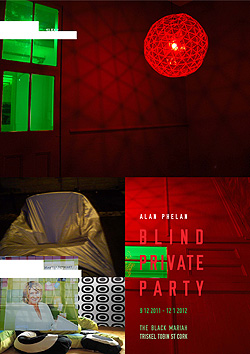
The Black Mariah, Triskel, Tobin Street, Cork 9 December 2011-12 January 2012
Obviously this is not a party, it’s an exhibition. The show is a selection of videos, fabric pieces, and sculptures gathered from different projects and places made over the last few years. While there should not be any connection between the pieces they actually cohere. As with many recent exhibitions of his work, Phelan has combined contrasting works to re-narrativise them, using old and new pieces to chart out another story, in this case a party of objects, blinded by ego.
There is always a mix several references with Phelan’s work, not just a semantic play, but proposing conflicts between given understandings and interpretations. This is an attempt to undermine the certainty of cultural assumptions through what has been termed as an “infrastructural aesthetic”. This concept allows for several parallel narratives to exist, linking the physical to the political to the societal to the individual. Visually the starting point is civil engineering, re-routed with unlikely content and materials. As with much of Phelan’s work there is an attention to detail and uncommon use of materials which constant shifts the viewer back onto the artwork.
The works in the show are therefore eclectic so as to reflect a complex reality of contemporary life [in Ireland] via the man behind our bankrupt economy, an overarching utopian failed fantasy, an emasculated super hero, a misogynist secret camera, the questionable futility of protest, engineering as non-functional decoration, and a fascination with assholes.
Associated text
Alan Phelan Blind Private Party
The Black Mariah @ Triskel, Tobin Street, Cork 8 December 2011-12 January 2012
Red Star Death Star, 2007 balsa wood, card, paper tape, cocktail sticks, glue, coloured polyester thermal film, light fixture, cable 75 x 75 x 75 cm This apparent lamp shade is actually a geodesic version of the Death Star from the Star Wars movie. It’s a poor approximation of a utopian design for possible socialist architecture fused with a plant destroying weapon, rendered domestic with a low wattage light bulb placed inside it.
Larkin Man adhesive vinyl 100 x 82 cm This is maybe an idealised yet emaciated worker, taken from the masthead graphics of ‘The Irish Worker’ newspaper edited by James Larkin, now blindfolded.
Rosebud Tunnel Face, 2011 cut velvet curtain fabric, printed cotton, adhesive 240 (high) x 197 (wide) cm This hanging fabric piece is a clash of designs, fused by a complex pattern based on the front face of the tunnelling machine that historically dug through the Gotthard tunnel in Switzerland earlier this year. It is both pattern, cresting rosebud hole, and infrastructural mandala.
Thing, 2010 cotton sheet 150 x 150 cm (installed) sheet size 210 x 190 cm The Thing from the Fantastic Four proved ideal for rendering as lattice-work. He is both man and rock, strong and stupid, brave and reckless, absent and present, clear and clean. One bad pun that works on repeat as there are fifteen more similar pieces.
Protest Polar Bear, 2010 archival paper, EVA glue, toner, varnish 31 x 12 x 13 cms (papier-mâché made from an article from the Irish Times about the street paper collectors called Cartoneros in Buenos Aires, April 2010) This is not a rat, it’s a very small standing polar bear, protesting about climate change, and not hitch-hiking to Denmark. It’s about two countries that have no connection, about a world that is bent on the recycle, and a place where poverty is a career choice. This work is clustered with the following two in front of some fabric panels. They dead with peasant food and prophetic leftovers.
Cabbage Shade, 2011 light fixture, rubber leaves, wire, acrylic size: 23 x 40 x 40 cm
A Skull Perhaps, 2011 Leftover papier-mâché, acrylic rod skull size: 17 x 23 x 30 cm rod: 89 x 1 cm
Larkin Man, 2011 vinyl adhesive, fabric, adhesive graphic size: 100 x 82 cm
each fabric panel: 240 x 243 cm
Sweet, 2011 video projection, duration 4:48 mins Sweet is video mash-up, overlaying and mismatching rowdy singers from a bar in central Serbia with the lyrics from a song by the 1970’s pop duo The Sparks. The crudeness of the subtitles echoes a perception of country trapped in the past of mercenary isolation and robust sexist traditions.
The re-Birth of a Nation (without Brian), 2011 papier-mâché reading glasses, video projection, duration 3:24 minutes reading glasses size: 5 x 15 x 15 cm Symbolically simple, this short video image represents the state of the nation, or rather the state we have found ourselves in, or rather out. It’s sister work includes a mask of Brian Cowen which is thankfully unavailable at present for exhibition.
Sokea Yksityistilaisuus, 2011 vinyl adhesive text (limited edition sticker available for 20 quid).
Various groupings around the building (it’s the name of the show in Finnish)
Alan Phelan Blind Private Party The Black Mariah @ Triskel, Tobin Street, Cork 8 December 2011-12 January 2012
Press Release
The Black Mariah is please to announce an exhibition of new and recent works by Alan Phelan.
Obviously this is not a party, it’s an exhibition. The show is a selection of videos, fabric pieces, and sculptures gathered from different projects and places made over the last few years. While there should not be any connection between the pieces they actually cohere to explore several related ideas.
With Phelan’s work there is always a mix several references, which often conflict to propose or create new viewpoints and interpretations. This sometimes is an attempt to undermine the certainty of our cultural assumptions through what has been termed as an “infrastructural aesthetic”. This concept allows for several parallel narratives to exist, linking the physical to the political to the societal to the individual. Visually the starting point is civil engineering, re-routed with unlikely content and materials.
The works in the show are therefore eclectic so as to reflect a complex reality of contemporary life (in Ireland) via the man behind our bankrupt economy, an overarching utopian failed fantasy, an emasculated super hero, a misogynist secret camera, the questionable futility of protest, engineering as non-functional decoration, and a fascination with the asshole.
Alan Phelan (b. 1968 Dublin. Lives and works in Dublin, Ireland) studied at Dublin City University, Dublin, 1989 and Rochester Institute of Technology, New York, 1994. He has exhibited internationally in venues including Oksasenkatu 11, Helsinki; Mina Dresden Gallery, San Francisco; Cabinet, New York; Chapter, Cardiff, Whitney Museum of American Art, New York; SKUC, Ljubljana; Feinkost, Berlin; SKC, Belgrade. In Ireland he has exhibited widely including the Irish Museum of Modern Art, mother’s tankstation, Dublin; MCAC, Portadown; Limerick City Gallery of Art, and Solstice Arts Centre, Navan. He was editor/curator for Printed Project, issue five, launched at the 51st Venice Biennale, and has curated exhibitions at the Royal Hibernian Academy, Dublin, Project Arts Centre, Dublin, and Rochester, New York. Phelan was short-listed for the AIB Art Prize in 2007 for his work on the IMMA commission, Goran’s Stealth Yugo, 2009. He has completed several public art projects in Ireland, Wales and New York including projects for Dublin City Council, Dun Laoghaire Rathdown and the Department of Communications. His work is represented in the collections of the Irish Museum of Modern Art, Limerick City Gallery of Art, The National Self-Portrait Collection and several private collections.
Blind Private Party is not a party, it’s an exhibition. The show is a selection of videos, fabric pieces, and sculptures gathered by Alan Phelan from different projects and places, made over the last few years. While there should not be any connection between the pieces they actually cohere.
With Phelan’s work there is always a mix, often conflicting yet proposing new viewpoints and interpretations of familiar topics. This sometimes is an attempt to undermine the certainty of [our] cultural assumptions through what has been termed as an “infrastructural aesthetic”. This concept allows for several parallel narratives to exist, linking the physical to the political to the societal to the individual. Visually the starting point is civil engineering, re-routed with unlikely content and materials.
The works in the show are therefore eclectic so as to reflect a complex reality of contemporary life [in Ireland] via the man behind our bankrupt economy, an overarching utopian failed fantasy, an emasculated super hero, a misogynist secret camera, the questionable futility of protest, engineering as non-functional decoration, and a fascination with the asshole.
Parataxis
political history, cultural theory, psychoanalysis, science fiction and sexuality – shaped through interests in narrative, trans-cultural potential, and provisional meaning.
Perception
Language of bad puns
Maybe it will function as a party on the opening evening reception on 8th December.
Project Show of HIAP Resident Artist Oksasenkatu 11, 00100 Helsinki, Finland 22-26 October 2011
Several works were developed while on residency at HIAP over three months. Phelan worked in a variety of media which include fabric, papier-mâché and video. The underground tunnels of Helsinki city formed the starting point for work here. These allowed him to develop his interest in “infrastructural aesthetic”, a concept that allows several parallel narratives to exist, linking the physical to the political to the societal to the individual.
Phelan also screened for the first time, a video made in the underground car park chambers of Erottaja in Helsinki, built originally during the early Cold War years as an air raid shelter. The script was developed with Irish writer and psychotherapist Medb Ruane and has three unlikely characters discussing the psychology of car culture. The three argue over some of the nuances of the field from early Freud to the later Lacan, teasing out the illusive O-Object, or the unobtainable object of desire.
With Phelan’s work there is a mix of literal and symbolic references, encouraging conflicting viewpoints and interpretations, attempting to gently undermine the certainty of our cultural assumptions. The works in the show contrast greatly so as to engage political history, cultural theory, psychoanalysis, science fiction and sexuality – shaped through interests in narrative, trans-cultural potential, and provisional meaning.
The HIAP residency is in partnership with Temple Bar Gallery + Studios and supported by The Arts Council of Ireland.
Associated text
Alan Phelan
Sokea Yksityistilaisuus
Project Show of HIAP Resident Artist Oksasenkatu 11, 00100 Helsinki, Finland 22-26 October 2011
All works 2011
Brian’s Bright Future kansakunnan synty clay, cardboard, paper, paint, apples 35 x 21 x 28 cm
Checkers Paranoia (this is not a DUMB) allas pommisuoja kakku (tämä ei ole tyhmä) archival paper, EVA glue, toner 100 (long) x 18 x 46 cm
Larry the Centaur mies laama karitsan c-prints 20 x 30 cm
Suburban Faux Real itäkeskus kenkä fabric, c-print
Rosebud Window Tunnel Curtain nuppu malli vieraassa paikassa cut velvet curtain fabric, printed cotton, adhesive 240 (high) x 197 (wide) cm
Speaking of Drives oppia kokonaisuuksia video projection duration 17 minutes from the story by Medb Ruane
Prologue: Imaginary place, imaginary time. Footballer’s girlfriend Charlene Hume-Berkeley encounters former Carmelite nun, Dame Judy Tutler and Irish Nationalist Arthur Griffith, in Erottaja underground car park and tunnels, Helsinki.
Status and achievement fascinate Charlene Hume-Berkeley (25). She’s obsessing about what men want, however, because of an ebbing sexual rapport with her partner. Determined to star in her own reality TV show, she recently discarded her research into later Lacan and the art of handbagging because it’s bad for her image. Played here by RachelCheung.
Dame JudyTutler (39) lives currently as a celibate. Sometimes, she dreams of driving in the Leggendae Passione at Maranella, with her ideal lover by her side. A mechanic in her Carmelite years, Judy loves tinkering with various Scaglietti-designed, pontoon-fendered Ferrari 250 TRs. Her wish list number one is to inspect all 22 constructed between 1957 and 1958. Played here by Fionna O’Sullivan.
In another life, Arthur Griffith (1872-1922) might be DJ’s ideal. Editor, essayist and politician, his article ‘The Resurrection of Hungary’ (1904) questions how sovereignty evolves for smaller countries within larger entities, there the Austro-Hungarian Empire. Coincidentally, the 15 years he spent (1895 -1910) as an engaged man overlap with key moments in Sigmund’s Freud’s articulation of psychoanalysis. Played here by Frank Boyle.
Acknowledgements: Many thanks to all who helped in this production made in such a short time-frame. Firstly the actors and crew Ulla Linnanvuo, Tomasz Szrama, Pii Anttila, Daniel Moynihan, and the many others who helped along the way including The Finn Brit Players, Thespians Anonymous, Toni Ledentsa, and Marita Muukkonen.
HIAP Press release:
For this exhibition, Irish artist Alan Phelan will present several works that have been developed while on residency at HIAP over three months. Phelan works in a variety of media which include fabric, papier-mâché and video. The underground tunnels of Helsinki city formed the starting point for Phelan’s work here. These allowed him to develop his interest in “infrastructural aesthetic”, a concept that allows several parallel narratives to exist, linking the physical to the political to the societal to the individual.
Phelan will also screen for the first time a video made in the underground car park chambers of Erottaja in Helsinki, built originally during the early Cold War years as an air raid shelter. The script has been developed with Irish writer and psychotherapist Medb Ruane and has three unlikely characters discussing the psychology of car culture. The three argue over some of the nuances of the field from early Freud to the later Lacan, teasing out the illusive O-Object, or the unobtainable object of desire.
With Phelan’s work there is a mix of literal and symbolic references, encouraging conflicting viewpoints and interpretations, attempting to gently undermine the certainty of our cultural assumptions. The works in the show contrast greatly so as to engage political history, cultural theory, psychoanalysis, science fiction and sexuality – shaped through interests in narrative, trans-cultural potential, and provisional meaning.
The HIAP residency is in partnership with Temple Bar Gallery + Studios and supported by The Arts Council of Ireland.
Alan Phelan Seeing Things That Aren’t There Sokea Yksityistilaisuus
Näyttelyn avajaiset: Lauantaina 22.10.2011 klo 18 alkaen
Gallerian aukioloajat: Sunnuntaina 23.10.2011 klo 12–18 Keskiviikosta Lauantaihin 26.–29.10.2011 klo 12–18
Oksasenkatu 11, 00100 Helsinki, Finland www.oksasenkatu11.fi
Näyttely esittelee useita irlantilaistaiteilija Alan Phelanin työn alla olevia teoksia, joita hän on työstänyt viimeisen kolmen kuukauden aikana HIAPin taiteilijaresidenssissä. Phelan työskentelee laaja-alaisesti niin tekstiilin, paperimassan kuin videotaiteenkin parissa. Nyt esiteltävien teosten lähtökohtana ovat Helsingin maanalaiset tunneliverkostot, joiden kautta taitelijaon kehittänyt kiinnostustaan “infrastrukturaaliseen estetiikkaan”. Käsite mahdollistaa useiden rinnakkaisten narratiivien olemassaolon liittäen fyysisen poliittiseen ja yhteiskunnallisen yksilölliseen.
Phelan esittää näyttelyssä ensimmäistä kertaa videoteoksen, joka kuvattiin maanalaisessa parkkihallissa Erottajalla, alun perin pommisuojaksi kylmän sodan alkuvuosina rakennetuissa tiloissa. Käsikirjoitus, jossa kolme erilaista hahmoa keskustelevat autokulttuurin psykologiasta, on kehitetty yhteistyössä irlantilaisen kirjalilijan ja psykoterapeutin Medb Ruanen kanssa. Videon kolme hahmoa kiistelevät alan nyansseista Freudin varhaistuotannosta Lacanin myöhäisempään tuotantoon, metsästäen petollista O-Objektia tai halun saavuttamatonta kohdetta.
Phelanin sekoittaa tuotannossaan sananmukaisia ja vertauskuvallisia viittauksia rohkaisten ristiriitaisiin näkökulmiin ja tulkintoihin yrittäen huomaamattomasti romuttaa kulttuuriset ennakko- odotuksemme. Näyttelyn teokset rakentavat suuria kontrasteja liittämällä yhteen poliittista historiaa, kulttuuriteoriaa, psykoalalyysia, sficiä ja seksuaalisuutta, jotka muokkautuvat kiinnostuksesta narratiiviin, kulttuurien väliseen potentiaaliiin ja suhteellisiin merkityksiin.
Alan Phelan (s.1968 Dublinissa, asuu ja työskentelee Dublinissa, Irlannissa) valmistui Dublin City Universitysta Dublinista 1989 ja Rochester Institute of Technologysta New Yorkista 1994. Hänen töitään on ollut esillä Irlannin ulkopuolella mm. Cabinetissa New Yorkissa, Chapterissa Cardiffissa, Whitney Museum of American Artissa New Yorkissa, SKUC:ssa Ljubljanassa, Feinkostissa Berliinissä sekä SKC:ssa Belgradissa sekä Irlannissa Irish Museum of Modern Artissa, mother’s tankstationissa Dublinissa, MCAC:ssa Portadownissa, Limerick City Gallery of Artissa, ja Solstice Arts Centressa Navanissa. Phelan toimitti/kuratoi 51. Venetsian biennaalissa julkaistun Printed Projectin numeron viisi ja on kuratoinut näyttelyitä Royal Hibernian Academy:n Dubliniin, Project Arts Centreen Dubliniin ja Rochesteriin New Yorkiin. Phelan oli ehdolla AIB Art Prize –palkinnon saajaksi 2007. Hän on totettanut useita julkisia taideprojekteja Irlannissa, Walesissa ja New Yorkissa, mm. Dublinin kaupunginhallituksen, Dun Laoghaire Rathdownin kreivikunnan sekä Irlannin liikenneministeriön toimesta. Hänen teoksiaan on hankittu Irish Museum of Modern Artin, Limerick City Gallery of Artin, ja The National Self-Portrait Collectionin kokoelmiin sekä useisiin yksityiskokoelmiin.
HIAP residenssi on toteutettu yhteistyössä Temple Bar Gallery + Studios sekä Arts Council of Irelandin kanssa.
Script for Speaking of Drives Alan Phelan
from a story by Medb Ruane
Meet at Korkeavuorenkatu 26, Erottajan pelastusasema at 10am
Prologue to original text for character breakdown and setting:
Imaginary place, imaginary time. Footballer’s girlfriend Charlene Hume-Berkeley encounters former Carmelite nun, Dame Judy Tutler, at a Show and Shine spectacle provoked by Alan Phelan. Re-worked now to the Erottaja underground car park and tunnels in Helsinki.
Status and achievement fascinate Charlene Hume-Berkeley (25). She’s obsessing about what men want, however, because of an ebbing sexual rapport with her partner [Lacan: There is no sexual relation, ie impossibility of being complete or completed]. Determined to star in her own reality TV show, she recently discarded her research into later Lacan and the art of handbagging because it’s bad for her image.
Dame JudyTutler (39) lives currently as a celibate. Sometimes, she dreams of driving in the Leggendae Passione at Maranella, with her ideal lover by her side. A mechanic in her Carmelite [nun: silent order] years, Judy loves tinkering with various Scaglietti-designed, pontoon-fendered Ferrari 250 TRs. Her wish list number one is to inspect all 22 constructed between 1957 and 1958. [born from Judith Butler/ Gender Trouble, great queer theorist, thinkin also practical/sensual, Judi Dench-feel tho younger cf in Bond films]
In another life, Arthur Griffith (1872-1922) might be DJ’s ideal. Editor, essayist and politician, his article ‘The Resurrection of Hungary’ (1904) questions how sovereignty evolves for smaller countries within larger entities, there the Austro-Hungarian Empire. Coincidentally, the 15 years he spent (1895-1910) as an engaged man overlap with key moments in Sigmund’s Freud’s articulation of psychoanalysis.
TITLEon black Dialogue 1: Driving dialectics in the hyper-modern era
INT Erottaja Car Park – underground parking hall, rows of parked cars under the roughly hewn, white painted, man-made cave. The three characters are grouped around one car and shots cut between them when they speak. They move between different cars at one end of the car park. Each dialogue piece from each actor is a mix of medium close-up (head and upper torso) and close-up (head and shoulders). Cutaways also between non speaking characters are important, reacting to dialogue related to them whether disapproving, affirmative or simply ennui.
The scene opens with a wide shot of the car park and then cuts to a medium shot of Dame Judy who is closest to a car and strokes it lovingly but respectfully.
DAME JUDY TUTLER
CUT MCU DJ You all know something about motors? I want to talk about their carnal delights. At the level of the body, CUT CU DJ I’m like a Mongolian horsewoman readying her steed for competition when I’m shinin’ my car. The rituals are the same whether you’re groomin’ a Fiat Punto or a Ferrari. CUT MCU HB I wash, rub, preen; polish ’til the skin glows. CUT WS GRP I enjoy the standing back then, walking round, CUT CU AG raising my eyes up, and down, as I seek wholeness and completion – in vain, CUT CU DJ of course, because there is never an oeillade, never a unifying moment where I can see it all at once and experience, CUT WS GRP what may I say, ecstasy? Mmmm … and the fragrances – sweaty engine oil boosting waxy sleekness, leather’s unguenty whiff, the interior’s taut, expectant aroma hovering, veiling …
ARTHUR GRIFFITH
CUT MCU AG You sound like Teresa of Avila, my dear! I’m more interested in the drives you inadvertently describe. I wish to explore them, if I may presume. Prof. Freud believed that they regulate sexuality and make us distinctively human in distinctively individual ways. CUT CU DJ It was a shock at the time, may I say. CUT CU AG They’ve nothing to do with biology, he found. Not one connects to instinct. CUT CU HB The tragedy is that the drives are unsatisfiable, relentlessly partial, CUT CU AG condemned to spark off their discontinuous components of pressure, end, object and source.
CHARLENE HUME-BERKELEY
CUT CU HB With respect, Arthur, that’s so old handbag. Your friend Freud changed his topography, you know, on top of opposing life drives and death drives. CUT CU AG Yes, the opposition mirrored old literary binaries CUT CU HB like Apollonian and Dionysian, or Eros and Thanatos, but Lacan sorted that. He’s more useful here because, after all, we’re considering something that’s creative and destructive – the art of boy racing versus the crime of boy racing. What’s different here? CUT CU DJ The drives are analogous to boy racers: they enjoy by pursuing a circuit, a closed circuit, quite repetitively. CUT CU HB There’s no final destination, it’s the doing, the re-doing, and re-doing some more. It’s about dicing with desire.
DAME JUDY TUTLER
CUT CU DJ A moment please, Charlene. I admire your poeticism Arthur, I always have. Let me share my thoughts about the boy racers, remembering the Mongolian horsemen … and my darlin’ Ewan McGregor filming there…
CHARLENE HUME-BERKELEY
CUT CU HB Pardon me, Judy. I’m trying to articulate something here and your cuts aren’t helpful. Every drive is a death drive for Lacan because it’s excessive, repetitive – even destructive. CUT MCU HB It’s no accident that we’re playing with the sound-sense of the boy racers’ “driving” and the “drives” as over a century of psychoanalysis has it. CUT CU DJ These are important signifiers. And, it’s no accident that many people hate boy racers at a gut level. CUT CU HB It’s almost primordial, that disgust, so we have to ask why. Something else is going on …
ARTHUR GRIFFITH
CUT CU AG You may think me old fashioned, Miss Charlene. I hesitate to correct a young woman yet I’m duty bound to introduce the term libido, which your master Lacan transformed into jouissance. CUT WS GRP I must inquire where the drives as you know them feature in your subjective panorama and how they are relevant there.
CUT WS HB walking away from the group
TITLEon black Dialogue 2: Myth and symbol in the hyper-modern era
INT Erottaja Car Park group gathered around a different car, in another part of the cark. They walk around the car while talking also. The scene begins again with a wide shot of the group.
DAME JUDY TUTLER
CUT MCU DJ Something marvellous happens when a human climbs inside a car and becomes as one with it. Vroom, vroom! The highway beckons, the future sheds limits. Years of enforced silence often leave me struggling for words, but in my imaginings, the racers are twenty-first century centaurs. Where does man stop and beast begin? Why are …
ARTHUR GRIFFITH
CUT MCU AG Shall I assist, Judy? You’re implying, if I may be so bold, that the racers are a trope, like centaurs are. You’re saying that they function rhetorically as fantasy figures carrying the burden of people’s fears and aspirations. CUT CU DJ Centaurs are extravagant inventions, as I saw with my own eyes when reviewing Slavic mythology in the early 20th century. CUT MCU AG They’re Dionysian hybrids, liminal beings born out of conflicting territories: our human world or the nether regions which may be benign, but represent as likely malign, CUT CU AG even malignant forces. We don’t know if they’re friends or foe, therefore we fear. We’re clutched by anxiety’s suffocating embrace.
CHARLENE HUME-BERKELEY (groans)
CUT CU HB Nature/culture? Limens and margins? Way too easy Arthur, too romantic. Next you’ll be dissertating on the archetypal implications à la Jung. What a loser.
ARTHUR GRIFFITH
CUT MCU AG I’m mystified as to why I irritate you, Miss Charlene. Surely there’s room to consider the centaurs, and by association the racers, as giving free rein to id representations and thus to uncontrollable inner wildnesses. CUT CU HB They represent the unrepresentable. CUT MCU DJ Dame Judy, let me introduce you to Freud’s second topography. He set it out during the Anglo-Irish negotiations which preoccupied me, although he doesn’t mention them. CUT CU AG Id–ego–superego: the id, or das Es as Freud also writes, doesn’t organise itself coherently; rather it’s the ‘great reservoir of libido’, ‘a chaos’ of unrelenting drives, here, life and death as I noted previously. He says the ego is like a rider trying to control a wild horse, it being the id. Is this the centaur’s domain, the boy racer’s?
CHARLENE HUME-BERKELEY
CUT MCU HB You may not mean to be so patronising, Arthur, but puh-lease give Judy a break. CUT CU HB Me too before I cliché my life away. Get real! Think about the real, the real Real, the rim round Das Ding, the void, chasm, the nothing at the core of being. Think about racers inscribing the deadly space we can’t name, challenging it like matadors, toreadors, whatever, brandishing red banners before huge, blank eyes that could kill.
DAME JUDY TUTLER
CUT CU DJ You’re losing me.
CHARLENE HUME-BERKELEY
CUT CU HB The racing knots the three registers, don’t you get it? Real, Symbolic, Imaginary. It’s a dazzling, desperate display of jouissance punctuated/punctured by limits. The car is like a carcass, an envelope – and the thought of it, the fantasy, is the hinge that knots carcass and subject together! Beyond, the death drive! Within, the hole of being! Or the other way round…
DAME JUDY TUTLER
CUT CU DJ I’m lost.
(A pause. Conversation resumes)
DAME JUDY TUTLER
CUT CU DJ The Gordon Bennett myth intrigues me. I understand he lived in real time yet if he did not, we’d have had to invent him.
ARTHUR GRIFFITH
CUT MCU AG What an unusual man. Rather like the primal father in Freud’s Totem and Taboo who enjoyed without limits. The exception. He did whatever he wanted whenever he wanted and no one could stop him, until the sons cooperated and killed him! Then they had to invent laws and regulations so it wouldn’t happen again. CUT CU AG In Bennett’s case, his vast wealth and media empire made everything possible.
CHARLENE HUME-BERKELEY
CUT CU HB Sounds like another speech is coming. Anyway, Darwin mentioned the primal father first. He was probably psychotic.
DAME JUDY TUTLER
CUT CU DJ Darwin?
CHARLENE HUME-BERKELEY
CUT CU HB No, Bennett. Or perverse, perhaps, because he acknowledged the Law without obeying it. He skirted around it, toyed with it. Here, though, the only way the racers can do what they do is to respect limits.
DAME JUDY TUTLER
CUT CU DJ The intervention interests me. Am I using the right word, intervention? I’m into cars. You two are talking about God knows what. I read newspapers. I listen to Joe Duffy. People hate boy racers at a visceral level but of course the racers they hate aren’t the centaurs I love or the car-lovers I admire. What’s the difference?
CHARLENE HUME-BERKELEY
CUT CU HB It’s hyper-modernism via Foucault’s ‘new relational mode’ with the artist intervening almost as an analyst does; using witz, joke, parody, skill…
DAME JUDY TUTLER
CUT CU DJ What team does your boyfriend play for, Charlene?
CUT WS GRP DJ and AG look toward HB who remains silent
Solstice Arts Centre, Navan curated by Belinda Quirke 29 October 2010 – 27 November 2010
Cabbages and Things contains two works, paper Cabbages and fabric Things each made in many multiples, filling the galleries with newsprint cabbage stucco and the piercing stares of superhero The Thing cut from fabric remnants. Phelan continues his interest here in not only what art can mean but the different ways it can be made. The Cabbages were made in a series of fabrication workshops with hundreds of helpers over the past two months. The Things were made by Phelan alone, but using different versions of the cartoon superhero from the net, none the same but all somewhat emasculated when appearing in fabric scraps. Together the galleries are decorated with our bleak present though a labyrinth of crisis headlines and hopeless heroes who can never save the day.
Associated text
Cabbages and Things Solstice Arts Centre, Navan curated by Belinda Quirke opening reception Friday, 29 October 2010 at 7.30pm exhibition continues until Saturday 27 November 2010
Cabbages and Things contains two works, paper Cabbages and fabric Things each made in many multiples, filling the galleries with newsprint cabbage stucco and the piercing stares of superhero The Thing cut from fabric remnants. Phelan continues his interest here in not only what art can mean but the different ways it can be made. The Cabbages were made in a series of fabrication workshops with hundreds of helpers over the past two months. The Things were made by Phelan alone, but using different versions of the cartoon superhero from the net, none the same but all somewhat emasculated when appearing in fabric scraps. Together the galleries are decorated with our bleak present though a labyrinth of crisis headlines and hopeless heroes who can never save the day.
Phelan’s artworks are often caught in a seemingly unfinished space with his use of found and raw materials. Phelan further infuses his production methods and works with complex and often conflicting narratives. This has been described as an ‘infrastructural aesthetic’ which not only encodes the materiality of the artwork but demands that the work be read from several possible positions.
This exhibition builds on work that formed part of his much acclaimed Fragile Absolutes project that was exhibited last year in solo exhibition at the Irish Museum of Modern Art and Chapter in Cardiff. The Cabbages were first made in similar workshops last winter in Cardiff and as with all of Phelan’s newspaper paper works the articles were specific to the context. For Chapter the Cabbages were made from copies of defunct Dublin newspapers that covered the Great Lock-Out of 1913 combined with articles from the Welsh miners strikes in the 1980’s and the then current postal strikes in the UK. Placing labour history into the process and product of the pieces was contrasted by their arrangement which was based on the Baroque ceiling plasterwork in the Chapel at IMMA/RHK, thus fusing distinct social and cultural moments. If a cabbage represents the classic peasant food, when fused with headlines they become something else encapsulated in the subtitle for the work – symbolic history ‘spectral’ fantasmatic history.
For Solstice the newspaper articles sourced and selected by participants have drawn on the current economic crisis, with the Cabbages forming a kind of moribund recession synopsis. Their arrangement echoes the architecture of the building, with even some exiting the gallery into the tiled ‘sky gardens’, with aluminium sheets from the 3 colour litho printing providing the printed material for the outdoor Cabbages. The paper cabbages form a disjointed labyrinth through the galleries, guiding viewers to the Thing works. These fabric pieces also build on a previous work Phantom Blanket, 2008 which presented the cut out face markings of Darth Maul from Star Wars in a found orange blanket. Similarly here the face of the super strong, super loser mutated superhero The Thing from the Fantastic Four is cut from a variety of fabric remnants and scraps, including leather, bed sheets, embossed vinyl, embroidered fabrics and man-made silks. The hapless Thing is graphically represented in a myriad of sources and a selection of these provide the basis for the cut-outs. His expressions waver between ultra tough guy and meek chimp-like expressions, all trapped in an inconsiderate fabric hanging or fabric object.
Phelan continues to examine various ways of making art through collaborations, tertiary sources and outside fabricators. This acknowledges and brings to the forefront the many ways art gets made and how authorship is now sometimes more confused than diffused. For Solstice he decided to engage with local audiences directly by having them help make it. This way of working is somewhere between participatory, relational and community practices with Phelan having positions for and against each, settling on fabrication workshop as a way to more honestly describe what has taken place. Eleven cabbage fabrication workshops took place over the past two months which include participants from Navan Youthreach, Dunboyne Flower Club, Mercy secondary school, Meath Arts Group, and DIT fine art students. Their labour, company and time are much appreciated by the artist and Solstice Arts Centre.
James Merrigan ¯DECEMBER_2010_ALTER-EGO(LESS) ALAN PHELAN_Cabbages and Things_Solstice Arts Centre_Navan_ October 30 – November 27_2010_
Once the Irish were good at political and religious segregation: there actually existed a political left and a right, no centre, no grey area. We were also good at land demarcation: it seemed divisiveness was in the blood. But then capitalism entered the mix, with a smidgin of feminism, a dash of democracy, and the ‘anything-goes’ cherry of postmodernism, and ‘truth’ went a shade of grey. The stone walled fields to the West are quirky remnants of our obsession with land ownership. The current economic crisis is blamed on the banks, but it was our ingrained desire to possess good auld ‘blocks and mortar’ that was the genesis of this crisis.
Walking through Navan town centre en route to Solstice Arts Centre to see Alan Phelan’s solo show, ‘Cabbages and Things’, I notice the streets are static with, ironically enough, gobs of people for a midweek afternoon: it feels like a filmset between takes. One man wears plaster-splashed workwear, but he is just ‘hanging’, with false optimism―NO WORK HERE!
Phelan’s ‘Cabbages and Things’ is a temporal seesaw. The artist’s visual metaphors, built on the unusually textured back of one ugly superhero, and formed from the printed matter of our economically sunk era, slips between boyhood nostalgia and adult crisis.
Semantics is as good a place as any to start discussing Phelan’s textually layered work. Words can sometimes be powerful conduits for latent memories when constructed from sensory experience. The word ‘Cabbage’ was an unpalatable word for me as a kid: I can smell the sweaty steam (with a hint of BO) from the pressure cooker. It could be a rural colloquialism, but for those of you not from such a backwater, ‘cabbage skin’ refers to the unpleasant skin odour you might get from drinking too much the night before. Contextually apt, the loitering Navanites that I passed on the way to the arts centre could be described as ‘cabbaging’, combined with a tangible staleness in the air.
On the other hand, “Things” could be equated directly with art, as a hard, or no need to define, functionless object. But, “Things” for Phelan references the unlikely superhero, ‘The Thing’ (Ben Grimm), from The Fantastic Four by Marvel Comics. Although The Thing was an American manifestation from the middle-aged Jack Kirby and Stan Lee, the former admits that the character was shaped by a challenging childhood growing up in New York’s Lower East Side. Phelan either has an affinity, or empathy, for the science-fiction fantasy hero, the likes of ‘Darth Maul’ from Star Wars and ‘Odo’ from Star Trek Deep Space Nine, have been chosen ‘art protagonists’ in his previous work.
This pattern of nerdy character appropriation is not just for the sake of ‘cool’. These drawn, plastic, computer generated superheroes and villains have a long printed history: a teenager’s morals and ideology are oftentimes borne out of reading, and living through the flawed superhero.
Personally, The Thing is Phelan’s best character appropriation yet. Why? For the very reason that The Thing is a printed character which aligns with Phelan’s own layering of political history in his continuing use of the printed newspaper, especially in his previous character busts of Éamon de Valera in Éamon Often Spoke in Tongues, and Odo in Barbara’s Boy (The Alternate).
Phelan’s ‘Things’ are injected with a psychodynamic pensiveness. Unlike other superheroes, The Thing cannot hide his deformity in either an awkward alter-ego or spandex mask. On the outside, he is more villain than hero. That is why his character development has an added amount of insecurity and self-pity: ultra-human traits. When Phelan cuts the character’s unfortunate facial template into a piece of fabric, which could otherwise act as a mask, there is a paradox between exposure and covering-up. In these instances, the artist achieves pathos for the ‘Things’. Phelan’s repeated portrait of the character further frustrates the paradoxical covered/exposed conflict: we are left to imagine the vain effort made by the ‘ugly’ Thing to cover up with a cut-out fabric portrait of himself; the mask ends up ‘unmasking’ the primary characteristics of The Thing’s deformity.
Pinned to the white walls of Solstice Arts Centre, Phelan’s ‘Things’ are transformed into prophets of torment—kitsch ‘Turin Shrouds’. The best of the ‘Things’ is cut-out in a striped pink|grey|white cotton bed sheet that is strewn on the gallery floor: a signifier for an unkept teenage boy’s bedroom, the space where the superhero is born.
The “Cabbages” element in Phelan’s solo exhibition are sculptural counterparts to the flattened ‘Things’: it’s important to note that the newspaper cabbages were made by local people in a series of fabrication workshops. The press-release states that “The cabbages form a disjointed labyrinth through the galleries [some exiting the gallery into the tiled sky gardens], guiding viewers to the ‘Thing’ works.” This is a very functional description of their purpose, as a secondary guiding-light to the primary devotional ‘Things’. The cabbages segregate rather than lead the way (the reference to the granite stone walls to the West of Ireland earlier was probably suggested to me by the textural grey configurations of the cabbages in the gallery). They are almost funerary in how they mark the ground, wreath-like, as if commemorating something that is dead, concluded, long-gone, devoid of colour, archival. In other instances they look like playful, ecological signifiers, as they traverse Phelan’s improvised wooden trellises. The trellis display could also be equated with the elderlies’ partiality for gardening: Phelan spans the age of man, from comic book adolescence to green-fingered old age. But then again, when you manage to decipher the word “BAILOUT” in the elegant ‘origami’ cabbage heads, you are brought back to the present, a permanent immanence, the newspaper headline is held in time, paused, as we loiter as a culture for what will economically befall us in the future.
Phelan’s trilogy of exhibitions contain elements of his broad-ranging reactions to Slavoj Žižek’s turn of the millennium book “The Fragile Absolute: Or, Why Is the Christian Legacy Worth Fighting For?” Phelan’s artworks within each exhibition have unfolded as alternative chapters to Žižek’s thoughts. The compelling narratives that run through the exhibitions present humanity’s desperation and insecurity through the twists and turns of a society seeking to redress the loss of some assumed equilibrium. In each, Phelan clearly indicates through a myriad of narratives that intersect with popular culture, revolutionary history, and the contradictions of contemporary revisionism.
The exhibition included the premier of two new films Include Me Out of the partisans manifesto and Speaking of Drives, Dialogue 3 as well as several other new works.
Society’s nervousness about what is reality pervades the exhibitions, and in Part Three Phelan makes his most personal manifesto. He shows a bleak belief in history, perhaps best displayed in the text drawing Provisional People, a tracing of words from the 1916 Irish Proclamation of Independence. As such the exhibition opens with a discomforting mix of players and icons.
This is not just a political statement, it is also the personal history of the degraded life that each individual sought out. Hope is not something that Phelan provides lightly. With Include Me Out of the partisans manifesto, we find a suburban couple battling through the apparent obliteration of their shared experience. As their DVD collection is painstakingly broken up and recycled, the male character works through inner torment interspersed with his dreams of what could have been. The film adopts several cinematic tropes to address the cyclical nature of ideas and how process implicates content.
The expectation brought by the psychic animals in The Seven Oracles, a new marble installation, objectifies moments of humanity seeking out a confirmation of what the future will bring, albeit through predicting the results of football matches. Times may pass, but the games continue and so does the insecure human need to know.
In Speaking of Drives, Dialogue 3 an improbable encounter of Arthur Griffith, an ex-nun mechanic and a footballer’s wife in a nuclear fall-out shelter and underground car park, results in a conversation about the very nature of desire. The discussion centres around the ‘o-object’ from conflicting psychological perspectives – old, new and intuitive – resolving little and soon parting ways.
Phelan renders this ‘o-object’ differently in the form of a scent, available as a cologne and also diffused through the gallery as a room fragrance developed with Demeter Fragrance Library – a company specializing in smells as memory triggers. Orange Rim Cleaner is the sweet chemical odour of a wheel degreaser used by modified car enthusiasts at a Show and Shine event organised by Phelan in 2006. The work grapples with the o-object, as an ultimate dematerialized artwork, the unobtainable object of desire, yet now re-packaged in a 30 ml bottle.
The dominant theme of car culture in Phelan’s recent work is represented with the first showing in Ireland of the original blue print design for the car sculpture Goran’s Stealth Yugo. Made in Serbia in 2006, the piece was an important starting point for this project which now draws to a tentative close.
Associated text
Limerick City Gallery of Art 11 October 2012 – 23 November 2012
PRESS RELEASE
Limerick City Gallery of Art presents “Fragile Absolutes Part 3” by Alan Phelan curated by Helen Carey
Previewing Thursday, 11th October, the exhibition will run in Limerick City Art Gallery until 25th November, 2012. The exhibition will include the premier of two new films Include Me Out of the partisans manifesto and Speaking of Drives, Dialogue 3 as well as several other new works.
The exhibition will be opened by Seán Kissane, Curator at IMMA.
Phelan has created a trilogy of exhibitions that contain elements of his broad-ranging reactions to Slavoj Žižek’s turn of the millennium book “The Fragile Absolute: Or, Why Is the Christian Legacy Worth Fighting For?” Phelan’s artworks within each exhibition have unfolded as alternative chapters to Žižek’s thoughts. The compelling narratives that run through the exhibitions present humanity’s desperation and insecurity through the twists and turns of a society seeking to redress the loss of some assumed equilibrium. In each, Phelan clearly indicates through a myriad of narratives that intersect with popular culture, revolutionary history, and the contradictions of contemporary revisionism.
Society’s nervousness about what is reality pervades the exhibitions, and in Part Three Phelan makes his most personal manifesto. He shows a bleak belief in history, perhaps best displayed in the text drawing “Provisional People”, a tracing of words from the 1916 Irish Proclamation of Independence. As such the exhibition opens with a discomforting mix of players and icons. The hoodied figure of a criminal hiding their identity on exiting court is rendered only as a garment, solidified in paper and glue. The work is sternly partnered with a bust of Roger Casement re-worked as a house plant. Both exalt and disrespect in equal measure.
This is not just a political statement, it is also the personal history of the degraded life that each individual sought out. Hope is not something that Phelan provides lightly. With Include Me Out of the partisans manifesto, we find a suburban couple battling through the apparent obliteration of their shared experience. As their DVD collection is painstakingly broken up and recycled, the male character works through inner torment interspersed with his dreams of what could have been. The film adopts several cinematic tropes to address the cyclical nature of ideas and how process implicates content.
The expectation brought by the psychic animals in The Seven Oracles, a new marble installation, objectifies moments of humanity seeking out a confirmation of what the future will bring, albeit through predicting the results of football matches. Times may pass, but the games continue and so does the insecure human need to know. In Speaking of Drives, Dialogue 3 an improbable encounter of Arthur Griffith, an ex-nun mechanic and a footballer’s wife in a nuclear fall-out shelter and underground car park, results in a conversation about the very nature of desire. The discussion centres around the ‘o-object’ from conflicting psychological perspectives – old, new and intuitive – resolving little and soon parting ways.
Phelan renders this ‘o-object’ differently in the form of a scent, available as a cologne and also diffused through the gallery as a room fragrance developed with Demeter Fragrance Library – a company specializing in smells as memory triggers. Orange Rim Cleaner is the sweet chemical odour of a wheel degreaser used by modified car enthusiasts at a Show and Shine event organised by Phelan in 2006. The work grapples with the o-object, as an ultimate dematerialized artwork, the unobtainable object of desire, yet now re-packaged in a 30 ml bottle.
The dominant theme of car culture in Phelan’s recent work is represented with the first showing in Ireland of the original blue print design for the car sculpture Goran’s Stealth Yugo. Made in Serbia in 2006, the piece was an important starting point for this project which now draws to a tentative close.
Born in Dublin in 1968, Alan Phelan studied at Dublin City University and Rochester Institute of Technology, New York. He has exhibited widely internationally including Whitney Museum of American Art, New York; Chapter, Cardiff, SKUC, Ljubljana; Feinkost, Berlin; SKC, Belgrade. OK11 Helsinki, IMMA, Dublin, mother’s tankstation, Dublin; MCAC, Portadown; Limerick City Gallery of Art, and Solstice, Navan and The Black Mariah, Cork.
He was editor/curator for Printed Project, issue 5, launched at the 51st Venice Biennale, and has curated exhibitions at the Royal Hibernian Academy, Dublin, Project Art Centre, Dublin, and Rochester, New York. Work on this exhibition was short listed for the AIB Art Prize, 2007.
The exhibition is accompanied by a fully illustrated catalogue with essays by Seán Kissane, Curator, IMMA; Dušan Bjelic, Professor of Criminology at the University of Southern Maine in Portland, USA; Medb Ruane, writer and journalist, and Tony White, novelist and journalist.
LCGA would like to acknowledge the kind assistance of Demeter Fragrance Library, IMMA, and lenders to the exhibition.
Fragile Absolutes Part 3 – LCGA – Alan Phelan
Include Me Out of the partisans manifesto, 2012 single channel video projection
This a short film about a couple having an argument over the destruction and recycling of their DVD collection. The script was developed from a catalogue essay on Phelan’s work by Tony White who used notes given by the artist to constructed a parallel narrative about Phelan’s practice. The film’s seemingly ordinary narrative is complicated by an intense internal monologue which shifts the tension to address the cyclical nature of ideas and how process implicates content. While the characters could represent Phelan, the story is not so literal and it is more the process they engage in that makes the connection.
The dialogue and voice-over is not so straight forward however as the narrative described above as the writer, Tony White, has a unique approach to writing fiction. He uses chunks of appropriated text derived from non-fictional sources, as he describes it “cutting-up, remixing and renarrativising fragments”. These included the Žižek notes plus chunks from a recycling website, an Indian site explaining papier-mâché, a text about motoring in the Balkans, and partial transcripts from the Slobodan Milosevic war crimes tribunal.
The design of the film also adds a further narrative layer. The styling, costumes and music soundtrack are based on Gattaca, the 1997 science fiction film yet share none of the genetic –determinist content that the film grapples with. There is however an interesting connection to the debate the film stirred through its flawed science and heroic tragedy not unlike some of the key arguments made by Žižek. Overall the piece takes on the diegesis of the cinematic narrative, only to fall short and end with full closure.
Scent of Orange Rim Cleaner (object petit object), 2009-2012 limited edition cologne, scent, delivery system developed by Demeter Fragrance Library
In 2009 Irish artist Alan Phelan contacted Demeter about mixing up a fragrance for an upcoming museum show. He wanted to re-create the smell of an orange scented wheel de-greaser that was used by modified car enthusiasts at an event he had organised a few years prior. The smell of this cleaner was his strongest memory of the day, where modified car owners cleaned their parked cars all day prior to judging in a “Show and Shine” competition.
Rather than show photographs or make some kind of ‘boy racer’ artwork, the memory trigger through fragrance was how Phelan wanted to represent the idea. As an art piece the scent grapples with the o-object, as ultimate dematerialized artwork, an unobtainable object of desire, a smell.
The project is connected to a multiple venue exhibition called “Fragile Absolutes” which worked through a range of different themes and productions methods. The limited edition cologne is being issued in for the 2012 show at Limerick City Gallery of Art, with 100 signed bottles.
Text from the 2009 museum wall label:
The Lacanian term petit objet a, sometimes known as the O-object stands for the unattainable object of desire. As Žižek says, it “condenses the impossible deadly Thing, serving as its stand-in and thus enabling us to entertain a livable relationship with it, without being swallowed up by it”. This specially commissioned fragrance is reminiscent of a strong orange scented degreaser used by some modified car enthusiasts to clean their wheels in preparation for a Show & Shine event organised by Phelan in Portadown in 2006 at MCAC. As Dame Judy says in Medb Ruane’s essay: “That they are always partial and unsatisfiable. You lose your o-objects, don’t you dear? Losing them mobilises your desire so they’re causal from the moment they’re lost. O-objects are primordial provocatives!”
Death Drive, 2006 commercial screenprint 6, 60 x 60 cm IMMA edition of 40
When modified car enthusiasts get together they sometimes turn into boy racers. The showmanship of this pastime is pretty central to the owners of these glammed, pimped-up cars. It’s not just the bodywork that gets modified, however, but also sometimes the engine. Some meet late into the night for private races on public roads. These also include burnout sessions which leave behind circular patterns of rubber on the road surface. Freud’s ‘death drive’ postulates a drive leading potentially towards death, destruction and non-existence, although Lacan resolved this in a different way.
Goran’s Stealth Yugo, 2006 diazo print 200 x 450 cms
This car design is a drawing of the most popular model of car made by Yugo (Zastava Automobili) and the only one in production from this former giant of Serbian industry when Phelan visited the factory in 2006. It was made in collaboration with car designer Goran Krstic from the factory in Kragujevac. The car is based around a defunct or out of production Fiat model and was the most common car on the roads (and also the cheapest). Zastava had strong market links with the ‘non-aligned’ nations which the former Yugoslavia was a leading political player. The factory has since been bought by FIAT and is currently being re-purposed into a spare parts facility.
This design however was eventually realised as a 3d work in 2009 and installed in the Formal Gardens of IMMA for 6 months. The sculpture was fabricated by Goran Krstic in Kragujevac utilizing many of the car manufacturing skill sets of the local population.
Provisional People, 2007 ink on paper 57.5 x 76.5 cms
Hopital Irlandaise, 2007 ink on paper 57.5 x 76.5 cms
These two drawings are traced from text in other images. Provisional People are two words plucked from the 1916 Declaration of Independence issued from the GPO. Hopital Irlandaise is taken from an photo of the hospital that Samuel Beckett volunteered in during the Second World War.
Roger should have stayed in the jungle, 2006 archival paper, toner, EVA glue, balsa wood, rubber car tyre, terracotta pot (papier-mâché made from articles from the Daily Telegraph) 34 x 27 x 27 cms, with pot 54 x 67 x 58 cms
Roger Casement is a troubled Irish patriot, poet, revolutionary and nationalist hero, being of a Protestant background, knighted for humanitarian work in Peru and the Congo, but executed for treason after a failed gun running attempt in a German submarine. His treason court case was made more controversial by the revelation of disputed forged diaries containing frank accounts of homosexual activities.
Woman who stole from farmer (it is only truth that matters), 2009 archival paper, EVA glue, toner 77 x 79 x 59 cms
In February 2009, a story appeared in the Irish national media concerning a Woman who stole from a farmer. This work is based on an image from the Irish Times showing the Woman covering her head and face with a striped hooded shawl while exiting the court. Kathleen Lewis (55), a mother of 10, was found guilty of stealing or rather bribing through intimidation, up to €70,000 from retired farmer George Berry (88), after an incident in the car park at a Centra store in Killeagh, Co Cork, in March 2006. A car driven by Berry was reputed to have damaged Lewis’s car, in which two of her grandchildren were alleged to have been thrown by the impact and injured. In sentencing, the Judge said “This is a particularly nasty and unpleasant crime”.
The Seven Oracles, 2012 marble, adhesive sticker, plywood, polish, varnish 350 x 250 x 30 cm
This installation of seven carved marble animals derived from the fad of psychic animals predicting scores of football matches – Paul the Octopus from the 2010 FIFA World Cup being the most famous and accurate. Soft toys manufactured in China were sent back to their country of origin to be carved in black marble. Brought together now on a geometric floor arena these psychic friends now command a selection of cross-references where orifices become oracles, zodiacs are re-inscribed as Pythagorean, abject turns to marble. It’s a faux transformation, fixated on the mis-understanding of fact, the deliberate distancing from truth.
FYI the animals are Paul the Octopus, Leon the porcupine, Petty the pygmy hippopotamus, Jimmy the Peruvian guinea-pig, Mani the Parakeet, Pino the Chimpanzee and Apelsin the Red River Hog.
Douglas (lacked the dimension of radical Evil), 2009 archival paper, toner, EVA glue, cocktail sticks, plywood, varnish, stainless steel basketball stand (papier-mâché made from pages in jPod 2006 novel where the character Douglas Coupland appears in the story) head: 34 x 21 x 28 cms stand: 100 x 250 x 250 cms
Douglas Coupland (born 1961) is a Canadian novelist probably best-known for his 1991 novel Generation X. He has written many novels which pretty accurately describe the work antics and social networking of young people and their search for meaning in an overly commodified world. His novels are generally quite sharp and witty, representing an ennui that is bleak yet very entertaining. In jPod, computer game workers encounter the character Douglas Coupland, appearing as himself, only really mean, shifting the course of the novel and quite narcissistically or self-reflexively causing mayhem and then saving the day.
Mine Past, 2012 Ink-jet print 111 (w) x 153 cm
This image of a wrecked stadium floodlight is from Tašmajdan Stadium which was built in the 1950s in Belgrade city centre. When Phelan photographed it in 2006 it seemed hugely symbolic of the mess that Serbia found itself in that post war time. It was one of many devastated buildings but this one had not been bombed by NATO like several government buildings in the city. Like Yugo it was a victim of several regime changes. The stadium is built into a large cliff, with the name derived from the Ottoman word for stone mine. Renovations on the structure are due to be completed in late 2012.
Speaking of Drives, 2011-12 Multi-channel video installation, painted graphic, monitors and cables duration 5 minutes
This is a multi-channel video where three improbable characters meet in an underground car park to uncover the meaning behind the elusive o-object from differing psychological standpoints. Imaginary place, imaginary time – footballer’s girlfriend Charlene Hume-Berkeley encounters former Carmelite nun, Dame Judy Tutler, and Irish Nationalist Arthur Griffith in Erottaja underground car park and tunnels, Helsinki. The script was developed from text written by Medb Ruane with the film covering the third section of the text.
Zastava Factory, Kragujevac, Serbia, 2006-2009 inkjet billboard sheets various sizes
These images are of the most popular car model made by Zastave (Yugo) being made in their factory and on the streets of the town where the factory is located.
Quotes from reviews and media coverage about the project:
Anyone looking for neat solutions to Phelan’s enigmatic riddles will be disappointed. These are not crossword puzzles to be deciphered but jumping off points for sometimes complex, sometimes subtle, connections. What’s really refreshing about Phelan’s diverse work is his refusal to get bogged down in any artistic tradition. Like many artists today he’s almost self-consciously working to avoid classification, working across a broad range of styles and materials. The result is some genuinely engaging and original work. Darryl Corner, The View, 8 Jan 2010, Western Mail, Cardiff
The work is a forceful manifestation of how concept can cluster into object to use imperfection as a formalistic vocabulary…It is this obfuscation that bolsters Phelan’s formal vernacular, drawing together a wide range of cultural subject matters and permitting them to coalesce into process. Maria Fusco, 9 December 2009, Frieze Art Magazine, London
Phelan’s play-acting lies between the subversive deconstructions of a theoretical academic and the mischievous questionings of a precocious kid. The Guardian, Saturday 22 August 2009
Expect to be led along more labyrinthine referential paths by an artist who loves the byways of semiotics. Aidan Dunne, The Ticket, 17 July, 2009, Irish Times, Dublin
Related quotes behind the work:
Žižek’s formless radicalism is ideally suited to a culture transfixed by the spectacle of its own fragility … Equally, it is hard to read this and many similar passages in Žižek without suspecting he is engaged – wittingly or otherwise – in a kind of auto-parody. The Violent Visions of Slavoj Žižek by John Gray’s review of Living in the End Times by Slavoj Žižek, Verso, 2012 in The New York review of Books, July 12, 2012.
they forgot the way it felt when time and emotions and culture were particular to one spot in time. From Player One, Douglas Coupland, Cornerstone Digital, 2010
Douglas Coupland – icon of a generation of disgruntled, pissy, bewildered people. Ah, how the joys of never knowing you outweigh the privilege of having met you. Sorry, dude. Dear Mr Coupland, Karolyn Close, Vodnik Publishing, 2012
Orange Rim Cleaner (flyer text)
Have you found your unattainable object of desire?
The elusive O object, a thing that remains in our heart and mind, a desire, a smell, has manifested itself in a new limited edition cologne designed by American fragrance house Demeter with Irish Visual Artist Alan Phelan.
Phelan seeks to represent the idea of triggering memory through fragrance. An amazing partnership with Demeter was forged as the opportunity to merge the perfumer’s art into the visual and spatial art of Alan Phelan became irresistible; Demeter being uniquely suited for this project because no other fragrance house works the relationship between scent and memory so intimately.
The project is connected to a multiple venue exhibition called “Fragile Absolutes” which worked through a range of different themes and productions methods. Originally designed for Phelan’s recent solo exhibition in the Irish Museum of Modern Art (IMMA), where its unique scent filled the air of one gallery, the limited edition version of the cologne is being issued for the 2012 show at Limerick City Gallery of Art, with 100 signed bottles, available only at the show itself, or www.DemeterFragrance.com for $30 or €25.
Limerick City Gallery of Art Series 1 Exhibition text 002 (gallery commissioned text response)
Michaële Cutaya 2012
Brian Duggan/Alan Phelan/Landscape II October 12 – November 23 2012
This exhibition, like the precedent, is in three parts, with contemporary paintings from the Limerick City Gallery of Art permanent collection and two solo shows by Alan Phelan and Brian Duggan. When the previous exhibition spanned across time, presenting works from 18th century masters to fresh graduates, it is the multiple forms of contemporary artist’s practices that captivate here. Landscape 2 is the second ensemble of landscape painting from the collection to be exhibited around Sean Cotter Forest. The first highlighted the painting’s connection with historical representations, the second, composed of contemporary artworks places the emphasis on the diversity of artists’ approaches on what is a landscape. The horizon line no longer dominates as other viewpoints are explored. The bird’s-eye view offers a close fit to the canvas dimensions but can also be the occasion for unexpected drama such as the striking Estuary by John Shinnors: the foaming white waters starkly held off by black geometrical water-gates. A closer attention to the landscape materiality and structure is reflected in the variety of mediums and supports, along with oil, painters have used acrylic, wax, collage, sand or glue on board, stretched and un-stretched canvas and paper: in Helen Comerford’s Untitled landscape is constructed out of bits of paper which are given all the solemnity of limestone. In these paintings the notion of landscape and place is explored as an objective material as well as an abstraction.
The addition of interpretive text panels next to artworks in the exhibition space is a debated issue amongst curators and artists. Text panels provide information useful to the visitor but they can be a distraction and become substitutes rather than supports for the artwork. Beside they tend to frame the viewer’s perception. LCGA is adopting a midway alternative in proposing interpretive texts as separate hand-outs thus leaving the space to the artworks. In Alan Phelan’s case, this raises interesting questions as text panels can be understood as part of the work itself. Phelan’s objects often present deceptively simple forms flirting with autonomy: impeccably finished like The Seven Oracles or delicately crafted like Woman Who Stole From Farmer (It Is Only Truth That Matter). In Phelan’s work, however, and as the later title suggests, there is a ot more going on than what meet the eye: the final form is the arbitrary result of interwoven narratives and processes or “works are constantly de-contextualised or re-contextualised through interdependencies” as wrote Sean Kissane in Alan Phelan’s IMMA catalogue. The Seven Oracles, for instance, are carved black marble sculptures made in China on the model of soft toys which were mass-produced – also in China – in the image of psychic animals that were supposed to predict the score of football matches: Paul the Octopus (World Cup 2010), Leon the porcupine etc… the unravelling of the implied threads from superstition to delocalisation is head spinning and place the marble soft toys oracle animals in a web of connections as complex as the geometrical diagram on which they are sited. Yet, to isolate them from their constitutive narratives might give space for the viewers to take in their incongruous shape and make their own connections.
Brian Duggan also works with contexts but through the transposition of physical environments into the gallery space – as in the on-scale reconstruction for Visual in
Carlow, of the wooden barn used for the roller skating scene in Michael Cimino’s Heaven’s Gate for Everything can be done, in principle. The human body in its exertions and limitations is the measure of Duggan’s work: The dancing bodies of boxers in a ring; the action of climbing onto a train roof and the space it needs to remain there; its ultimate frailty exposed in the x-rays of broken bones. Duggan invites the visitor to be an actor rather than a viewer, to put on roller skates, get lost in a maze or, here, to risk their bodies on one of the 23 crooked swings hung into the Carnegie Gallery for 23 Hour party people. This strategy also extends to his video installations.
In the latest attack on video art, the National Gallery of London director, Nicholas Penny, declared in an interview for The Art Newspaper:
The art form I don’t relate to – I’d put it more strongly actually – is video because it seems to me so often merely to be an incompetent form of film, made with the excuse that it is untainted by the professionalism associated with the entertainment industry.[1]
Video art has been an easy target for such sweeping statements as most gallery goers have suffered long hours of boredom in front of so-so video art, unlike painting that can be rejected at a glance – rightly or wrongly – video art requires more time. But to dismiss an entire art form? As both Phelan and Duggan are showing video works at LCGA which are very different in their aim and means it was a good occasion to be reminded of what video art as an art form can be that is definitely not a sub species of film.
There are two video installations in Duggan’s exhibition both showing videos reporting an event in a semi-documentary style. The first Your Loneliest Loneliness is a multi channel video of Thai Boxing matches on four monitors disposed ring-like around the Atrium gallery. Each proposes a different moment and viewpoint on the match. The videos taken with a hidden camera have been slowed or reversed emphasising the ritualistic aspects of Muay Thai: the dance-like move of the warming up, the massaging of the legs and even the fight itself come across as a repetition of immutable gestures and movements. The title refers to Friedrich Nietzsche’s concept of Eternal Return thus giving the disposition of the monitors another twist: the visitors have to physically circle the narrow gallery to view the four monitors, enacting the idea of repetition.
The second video installation We like it up there, it’s windy, really nice stages the projection of a film reporting the latest attempt by the Indonesian railway company to stop passengers from riding the roofs of the train. The new tactic consists in installing at outside stations an arc supporting a row of concrete balls suspended a few centimetres higher than the carriages. The film showing crowded train roofs, workers setting up arcs, trials to text the efficiency of the device with dummies, is projected from very close to the ground onto the corner of the Herbert Gallery in front of which variously sized blocks have been disposed and a replica of the concrete balls arc erected. This arrangement produces an occasional mirror effect between the film’s content and the replica, while the blocks, catching the light of the projection fragment the unity of the image: very much in the way that the dummies’ bodies explode on impact with the balls. A digital display of the titular sentence also run along the wall contrasting the gentleness of the wind touch with the violence of the bodies smashed by the balls. Duggan uses the possibility of an installation in the gallery space to externalise the impact of the film.
In a very different strategy, Phelan makes no less use of what the gallery space offers to present two video works. In the Link Gallery a multi channel video Speaking of Drives
played on wall-mounted monitors shows four different takes of the same scene simultaneously: three people meet in an underground car park in Helsinski (which doubles as nuclear shelter) to speak of ‘drives’. This is a fictional and carefully set up and edited film. After a succession of shots bringing us down via a mechanical stair to the car park the characters start a discussion going from car races to psychoanalytical interpretations of desire and death drives: each with a different perspective. As our eye navigates between the screens showing either the speaker, the listener or elements of the surrounding, cars or bolted doors, we are forced to split our attention between these different viewpoints and experience visually the analytical language we are hearing. The script is taken from a text by Medb Ruane ‘Speaking of Drives…routes and meanderings’ which was written for Alan Phelan’s catalogue in response to Phelan’s previous work on boy racers.
The original text by Tony white for Include me out of the partisan manifesto was also commissioned by the artist for the catalogue – transforming the later in a live element of the whole exhibition. This the most recent work presented by Phelan finished in time for this show. On the face of it is the most conventional looking film presented: it has a ‘professional’ look and is a film with actors on a set with careful photography. It is meant to look like a general release film. As with other Phelan’s work its ‘finished’ look is deceptive as all aspect of the film are the result of complex processes, mixing deliberate accident with random precision and leaving little to subjectivity and self-expression – however one defines it. Choosing Slavoj Zizek’s book The Fragile Absolute to follow the accidental narrative composed by the italicised words in the book as the ‘script’ for a series of exhibition with essays commissioned for a catalogue including the White’s text composed – prompted by the Zizek script – of re-arranged fragments of other texts which was then used as screenplay for Include me out the film. The photography, lighting, costumes, props of the film all follow the same scripted process. Naturalistic it isn’t. But it is a proposition that invite us to reflect on the processes of creativity and what originality might means in relation to a work of art. A quite literal demonstration of Roland Barthes idea of the inter-textual nature of all works as “resulting from the thousand sources of culture”[2]
Michaële Cutaya 2012
Published by the Limerick City Gallery of Art
[1] http://www.guardian.co.uk/culture/charlottehigginsblog/2012/oct/15/nicholas- penny-video-art?fb=optOut [2] Roland Barthes ‘The Death of the Author’, 1967
“I know very well that the Other’s culture is worthy of the same respect as my own: nevertheless … [I despise them passionately].” Slavoj Žižek, The Fragile Absolute
Part 2 of ‘Fragile Absolutes’ is a selection of new and recent works by Alan Phelan inspired by his ongoing engagement with political history, cultural theory, science fiction and photography. Within his practice he negotiates a number of sources and time periods: from found images, psychoanalysis and globalisation to current affairs, world war, popular fiction and boy racers. In doing so, he sets up a complex mix of literal and symbolic references, simultaneously providing background information on many of his subjects, yet leaving them open to conflicting modes of interpretation. In doing so he subtly undermines the certainty of our cultural assumptions and of the truth.
Several new pieces were exhibited at Chapter including the Cabbage sculptures which were made during a workshop working with participants from libraries and archives or with an interest in history. Participants were asked to bring newspaper articles about the Labour movement and specifically the Miner’s Strike in the 1980s. Phelan contributed copies of newspaper articles from the Dublin Lockout in 1914 with references to Labour leader James Larkin. These were made in to small paper cabbage sculptures by participants and arranged in the gallery to reference the Baroque Chapel in IMMA where the exhibition originated.
Other works included a single inkjet print that ran the length of the café at Chapter. Thti rock wie image was a slice of a NASA photo from Mars which showed a rock formation that looked like a human female figure. This form was recreated in red Turkish spaghetti rock. Also working from photography into sculpture a papier-mâché chicken form rotates slowly, powered by a solar panel illuminated by a gallery light. The form was taken from a blurred vintage image, referencing Futurist sculpture in agit-prop materials. The brown painted gallery presented works from the first chapter of the related Žižek text, all of which had popular culture science fiction connections.
The exhibition is a collaborative project between Chapter; IMMA, Dublin who commissioned and exhibited several of Phelan’s works earlier this year, and Limerick City Gallery of Art. The exhibition has received financial support from Culture Ireland.
Associated text
Chapter, Cardiff, Wales 11 December 2009 – 17 January 2010
“I know very well that the Other’s culture is worthy of the same respect as my own: nevertheless … [I despise them passionately].” Slavoj Žižek, The Fragile Absolute
‘Fragile Absolutes’ is a selection of new and recent works by Alan Phelan inspired by his ongoing engagement with political history, cultural theory, science fiction and photography. Within his practice he negotiates a number of sources and time periods: from found images, psychoanalysis and globalisation to current affairs, world war, popular fiction and boy racers. In doing so, he sets up a complex mix of literal and symbolic references, simultaneously providing background information on many of his subjects, yet leaving them open to conflicting modes of interpretation. In doing so he subtly undermines the certainty of our cultural assumptions and of the truth.
Often belying a keen understanding of a complex topic, Phelan’s sculptures are playful, sometimes superficially facile, and here combine an unlikely assortment of materials including papier-mâché, photographs, spaghetti rock and polyurethane foam all of which are handled adeptly and with intriguing results.
The titles, subtitles and structure of the exhibition are derived from a project Phelan completed during his time on IMMA’s Artists’ Residency Programme in 2008 where this project began. Taking the italicised words from the Slavoj Žižek book The Fragile Absolute – or, why is the Christian legacy worth fighting for? and using them as random word associations towards 15 ideas for works, realised in a variety of materials and processes.
In these, and other pieces, we see the artist humorously undermining the content of his own work by setting up sometimes inappropriate, or even tasteless, relationships between his subjects. These works operate side by side in a form of parataxis, without hierarchy – feeding off, informing and contradicting each other – yet shaped from Phelan’s interests in narrative, trans-cultural potential, and provisional meaning. As he reconfigures diverse elements they are lent a new voice – their context providing a means towards interpretation. A number of common elements can be discerned within the Fragile Absolutes body of work. They have a raw, unfinished quality – almost a sense of incompleteness which points to the artist’s intention of presenting discursive or dialogical structures in the place of ‘finished’ artworks. Dušan I. Bjelic uses Heidegger’s term Zuhandenheit to frame the materiality of Phelan’s practice, pointing to a type of ‘infrastructural aesthetic’ which focuses on what is left in the background of a philosophy rather than on what it specifically brings to light.
The exhibition is accompanied by a fully illustrated monograph produced by IMMA, Dublin, with essays by Seán Kissane, Curator, IMMA; Dušan Bjelic, Professor of Criminology at the University of Southern Maine in Portland, USA; Medb Ruane, writer and journalist, and Tony White, novelist and Leverhulme Trust Writer in Residence at the UCL School of Slavonic and East European Studies, London.
The exhibition is a collaborative project between Chapter; IMMA, Dublin who commissioned and exhibited several of Phelan’s works earlier this year, and Limerick City Gallery of Art. The exhibition has received financial support from Culture Ireland.
Death Drive (interrupt the circular logic of re-establishing balance because he is the lowest outcast), 2009 plywood, metal, varnish, flock
When modified car enthusiasts get together they sometimes turn into boy racers. The showmanship of this pastime is pretty central to the owners of these glammed, pimped-up cars. It’s not just the bodywork that gets modified, however, but also sometimes the engine. Some meet late into the night for private races on public roads. These also include burnout sessions which leave behind circular patterns of rubber on the road surface. Freud’s ‘death drive’ postulates a drive leading potentially towards death, destruction and non-existence, although Lacan resolved this in a different way.
“Pardon me, Judy. I’m trying to articulate something here and your cuts aren’t helpful. Every drive is a death drive for Lacan because it’s excessive, repetitive – even destructive. It’s no accident that we’re playing with the sound-sense of the boy racers’ “driving” and the “drives” as over a century of psychoanalysis has it. These are important signifiers. And, it’s no accident that many people hate boy racers at a gut level. It’s almost primordial, that disgust, so we have to ask why. Something else is going on …” says Charlene Hume-Berkeley, from the essay ‘Speaking of drives… routes and meanderings’, by Medb Ruane (from the essay in the Fragile Absolutes catalogue).
Scent of Orange Rim Cleaner (object petit object), 2009 scent, delivery system developed by Demeter Fragrance Library
The Lacanian term petit objet a, sometimes known as the O-object stands for the unattainable object of desire. As Žižek says, it “condenses the impossible deadly Thing, serving as its stand-in and thus enabling us to entertain a livable relationship with it, without being swallowed up by it”. This specially commissioned fragrance is reminiscent of a strong orange scented degreaser used by some modified car enthusiasts to clean their wheels in preparation for a Show & Shine event organised by Phelan in Portadown in 2006 at MCAC. As Arthur Griffith says in Medb Ruane’s essay: “That they are always partial and unsatisfiable. You lose your o-objects, don’t you dear? Losing them mobilises your desire so they’re causal from the moment they’re lost. O-objects are primordial provocatives!”
Clubbed Baby Seals (he is not aware how Jews really seem to him? this is not how things really seem to you), 2009 archival paper, toner, EVA glue, cocktail sticks, buttons (papier-mâché made from articles from the Wall Street Journal)
This sculpture is based on a news photo in which PETA protesters staged a mock seal slaughter by clubbing papier-mâché seals filled with red paint. The re-enactment took place outside Canada House in central London to protest the mass slaughter of baby harp seals on the ice floes of Newfoundland in March 2007. The papier-mâché is made up from the odd but useful index inside the cover page of the Wall Street Journal, which lists many of the key players in the world recession. The papers used were from the first six months of 2009 when recession hyperbole was best or worse depending on where you stood. The Žižek words really help to complicate the whole matter but things are never what they seem. Are they?
The Other Hand of Victory, Hebei version (ontological madness), 2009 marble 40 x 40 x 60 cms
After making a sculpture in 2007 called Pyrrhic Victory which was based on the Winged Victory of Samothrace (c. 220-190 BCE), Phelan finally visited the work at the Musée du Louvre the following year, having made the previous work solely based on web photographs. While there he saw the remains of her right hand housed in a vitrine. Back in Ireland, he purchased a wooden modelling hand from German mega-retailer, Lidl, and reconfigured it into an approximation of the Louvre hand with its missing fingers. This model was then sent to Hebei in China where local craftsmen who usually carve Greco-Roman garden statuary, scaled up the small hand in white marble. This cycle of global production mirrored another project he had been working on in Serbia but really reflected how ordinary things get made these days.
World War 1 in Colour (the void itself), 2009 inkjet billboard sheets each 92 x 133 cms
These billboard sheets are stills captured from a DVD offered free by The Irish Daily Mirror in 2008 from the TV series World War I in Colour (currently on permanent repeat over several cable channels). The text on each still is the subtitle already present in the video frame narrated by the lovely Kenneth Brannagh. The other Žižek italics that accompany the work point to the futility of war as an ‘almost-nothing’ ‘horror vacui’ and his discussion of the great Void that is Kasimir Malevich’s Black Square on White Surface is amusing as he gets the reference all wrong. Television offers us probably many more insights into how things happened, although it is more open to interpretation and far less passive that most would think.
Cabbage (symbolic history ‘spectral’ fantasmatic history), 2009 archival paper, toner, EVA glue, polystyrene
Cabbages represent possibly the classic peasant food whether it’s the green pulp on a plate of corned beef and spuds or the anaemic sauerkraut staple of Eastern Europe. They are possibly the opposite of everything in the subtitle but that just serves to make them more interesting. In this instance the cabbages are made from newspaper selected by the artist, gallery assistants and participants in a short fabrication workshop held in early December. Phelan began with printing pages from now defunct Dublin papers that covered the Great Lock-Out of 1913, a formative general strike that cemented the position of Unions with the Irish labour movement. With so much talk of strikes this seemed not only topical but something work addressing as Phelan was engaging a lot of free labour to help make the piece. As a trade-off participants got to make a cabbage to keep for themselves after the workshop.
Eamon Often Spoke in Tongues, 2007 archival paper, EVA glue, aluminium, balsa wood, faux snake skin leather, plastic pipe (papier-mâché made from articles from the Daily Telegraph)
This head is one of several that Phelan has made of Irish political figures. This work is a likeness of Éamon de Valera (1882-1975) who served as Prime Minister (Taoiseach) and President during his career which spanned the Easter Rising, the Civil War, formation of the Irish Free State and the political party Fianna Fáil. In many ways his is the grandfather of the Irish State but shifted his position from a militant republican to an arch social and cultural conservative, restricting social and cultural progress, locating an Irish ideal with essentialist and isolationist policies. His tongue is a fond from a Snake plant, sometimes mixed up with the Mother-in-Law’s Tongue plant, a common Victorian house plant, known for its ability to thrive in low light, endure irregular watering while helpfully removing toxins from the air.
Gallery 4 In this gallery there is a selection of individual works from the ‘Fragile Absolutes’ (the ones with the subtitles in brackets) but also several other works made over the past three years. What connects the pieces are shared references to science fiction and a negotiation with photography. Several of the works are three-dimensional renderings of objects that appear in photographs, like the Lady from Mars, or the chicken, goat and tunnel which all come from the same blurred image of a roadway in the south of Ireland. While it’s no great news that art is made from photos the works here traverse timeline that collapses past, present and future with a myriad of references that include the Shroud of Turin, Darth Maul, Umberto Boccioni, and Buckminster Fuller. Having studied photography, but more interested in making objects, Phelan harks back to his roots while trying his best not to make a photograph.
Clockwise from door: Blurred Chicken (you can, because you must!), 2009 paper, EVA glue, metal, paint, solar powered motor, battery, wood half pallet (papier-mâché made from articles from the Daily Telegraph)
Red Star Death Star, 2007 balsa wood, card, paper tape, cocktail sticks, glue, coloured polyester thermal film, light fixture, cable
Lady from Mars (coitus a tergo), 2009 fibre-glass, spaghetti rock, spray paint, glue
Phantom Blanket(there is no Christ outside of Saint Paul), 2008 orange blanket, push-pins
Lumpy half-Goat, 2008 archival paper, EVA glue, metal, paint (papier-mâché made from articles from the Daily Telegraph)
The man who ruins my break, 2007 c-type print, metal frame
All works courtesy of the artist and mother’s tankstation. Dublin
Café
Mars Piece, 2008 ink-jet print Courtesy NASA/JPL-Caltech
Last January someone noticed an apparent humanoid alien in one of photographs that NASA’s Mars Rover sent back from its red planet mission. These photos are made freely available on the web by NASA and it actually took over five years for this to be spotted. The blogosphere was afire with comments and ramblings about this female figure spotted in corner of a large panorama. This mural is a slice through the image, with the figure in the far left, which is actually only a few inches in size. This phenomenon, called pareidolia, where people see shapes in clouds or in blobs of ink, and it is the cause of many supposedly mysterious and miraculous events like sightings of religious figures in toast, bed stains or tree stumps. Inside the gallery Phelan has modelled up the figure using Turkish spaghetti rock which is a form of coral embedded with red sand and took a fibre glass model of a previous mock-up to define the Martian lady’s form which is really just a bunch of blurred pixels. One of the funniest blogs claimed that the image proved that the Danes were in fact an alien race given the figure similarity to Copenhagen’s Little Mermaid statue. Strange how we want aliens to look like humans when this is highly unlikely.
Alan Phelan : Fragile Absolutes
Cabbage Workshop @Chapter
As part of Alan Phelan’s forthcoming exhibition ‘Fragile Absolutes’, the artist is seeking participants for a short fabrication workshop to help realise an installation for the show.
The workshop will involve working with the artist in making up to 150 paper cabbages. Each cabbage has 16 leaves cut from A4 archival paper which has been photocopied with selected articles from various newspapers, each approx. 24 x 11 x 24 cm in size. A prototype is shown here. Participants will select their own combination of newspaper articles to make up cabbages from pre-selected publications dating from 1913-2009.
To explain more about the workshop and installation:
The full title for the work is Cabbage (symbolic history ‘spectral’ fantasmatic history), 2009. The workshop builds on previous participatory structure Phelan has explored as an artist which have involved various groups at several stages of the creative process.
In this instance Phelan is seeking assistance in selecting what newsprint articles are combined to make up individual cabbages as well as their actual fabrication. The articles to choose from begin with the labour movement history in Ireland with the 1913 Great Lock-Out which took place in Dublin. This was a six month strike across many industries which formalised the labour movement in Ireland. The newspapers already selected offer conflicting perspectives on the strike with various sensational headlines. Further instances of labour movement history will hopefully be provided by participants and gallery which can run up to the recent/current UK Post Office strike, Miner Strikes, early history or specific stories. The mix of new and old newspapers will point to many consistencies and contradictions in the labour movement, reflecting also the very nature of this fabrication workshop.
Each cabbage has 16 leaves cut from A4 archival paper which has been photocopied with selected articles from various newspapers, each approx. 24 x 11 x 24 cms in size. A prototype is shown above. Participants will select their own combination of newspaper articles to make up cabbages from pre-selected publications dating from 1913-2009.
The arrangement of the assembled cabbages will reference the baroque papier-mâché ceiling in the Chapel at IMMA, Dublin, a former 17th century British military hospital.
In these, and other pieces, we see the artist humorously undermining the content of his own work by setting up sometimes inappropriate, or even tasteless, relationships between his subjects. These works operate side by side in a form of parataxis, without hierarchy – feeding off, informing and contradicting each other – yet shaped from Phelan’s interests in narrative, trans-cultural potential, and provisional meaning. As he reconfigures diverse elements they are lent a new voice – their context providing a means towards interpretation. A number of common elements can be discerned within the Fragile Absolutes body of work. They have a raw, unfinished quality – almost a sense of incompleteness which points to the artist’s intention of presenting discursive or dialogical structures in the place of ‘finished’ artworks. Dušan I. Bjeliæ uses Heidegger’s term Zuhandenheit to frame the materiality of Phelan’s practice, pointing to a type of ‘infrastructural aesthetic’ which focuses on what is left in the background of a philosophy rather than on what it specifically brings to light.
Alan Phelan Cabbage Workshop @ Chapter 4th and 5th December 2009
Materials needed per person:
Plastic sheeting to cover work table
Photocopied A4 sheets or/and access to photocopier to make copies from newspapers
Evcon-R glue
Water
Bowl/Plate for mixing glue
Med sized paintbrush
Scissors
Hot glue gun with glue stick
Foam cone
Mylar plastic sheets with leave template/shape
How to Make Cabbages:
Select photocopied sheets in pairs – 16 sheets needed per cabbage although extra sheets can be used for additional large leaves
Cover table with plastic sheeting
Mix glue equal part water and glue in a bowl or jar – about 2 tablespoons glue
With a med sized paint brush, paint on the glue on the reverse of one A4 sheet
Place a dry A4 sheet over glued surface making sure the type is in the same direction on both sides – rub down with palm of hand to form a tight bond – excess glue will spill out but rub it into the paper (the glue is non-toxic)
Leave to dry separated and flat for 1 hour near a radiator or warm room – if the glue is used sparingly the sheets can be used while still damp.
Using the plastic templates cut out the leaf shapes from paper – there are 4 templates
Small size – cut 6 leaves from 1 A4 sheet
Med size – cut 6 leaves from 3 A4 sheets
Large size – cut 4 leaves from 2 A4 sheets
Large size with extended flap – cut 4 leaves from 2 A4 sheet
Snip top off top of cone
Take a small scrap of leftover paper and wrap the top. Glue in place with glue gun.
Starting with two small leaves begin attaching leaves to the cone – hot gluing paper to paper as much as possible. Each leave position is half way through the one beneath – also the tip of each leaf should be pulled back and crinkled (without tearing) before gluing.
As larger leaves are glued increase the size of the fold that the top of each leaf to ensure a wide crown. Also do not glue too tightly together – keep loose.
Use the large size with extended flap to cover the exposed cone and fold over onto base.
Alan Phelan @ Chapter Arts Centre, Cardiff, until January 17
WITH much of Alan Phelan’s new work, trying too hard to identify a logical narrative between the pieces on show – or indeed within each piece individually – is going to prove fruitless.
He’s often deliberately contradictory. A lot of the work shown as part of Fragile Absolutes has multiple cultural references and meanings, almost to the point of defying description.
While this can be frustrating for some, for others it’s the vagueness and spread of these connections that is going to prove engaging.
Equally diverse are the topics covered; modern obsessions like boy racers, and global economics rub shoulders with recent history, particularly that of Phelan’s native Ireland.
For instance, a pair of clubbed seals are created from papier-mâché. Phelan often uses photographs as starting points for three dimensional work and in this case it’s a reference to a press picture of the famous Canada House protests against the seal culls of Newfoundland. But the paper these tragic – and childlike – seals have been made from is taken from the Wall Street Journal and contains the names of many of the now defunct companies who came to public attention as “victims” of the recent recession.
More papier-mâché is used in the creation of a bust of Irish revolutionary Éamon de Valera. A one time co-owner of the Irish Press, de Valera – again rendered in newspaper – became notorious for his support for religious and social conservatism. Phelan’s sculpture depicts him with a curious, long snake-like tongue.
In one room, neat rows of cabbages are arranged in a curious pathway. Cabbages are a humble vegetable and a staple in many parts of Eastern Europe but Phelan’s cabbages are made – once again – from newspapers, created during a workshop held here at Chapter. But, of course, these aren’t random newspapers but reprints of pages from Dublin papers dating from the early days of the Irish uprising.
Once again, the references – often driven by convoluted titles – are multi-layered but the harder you try to pin down the logic the further it twists away, just out of reach.
Another room is filled with large images grabbed from the TV series World War 1 in Colour. Each has a subtitle taken from the original programme. These images detail the events that led to the outbreak of the war. We’re so used to seeing this period in history in emotionally-distancing black and white that its presentation in colour, and arranged like banks of television monitors in a newsroom, suddenly brings it forward in time and prompts parallels with contemporary conflicts.
Anyone looking for neat solutions to Phelan’s enigmatic riddles will be disappointed.
These are not crossword puzzles to be deciphered but jumping off points for sometimes complex, sometimes subtle, connections.
What’s really refreshing about Phelan’s diverse work is his refusal to get bogged down in any artistic tradition. Like many artists today he’s almost self-consciously working to avoid classification, working across a broad range of styles and materials. The result is some genuinely engaging and original work.
Irish Museum of Modern Art, Dublin Lower East Wing Galleries 22 July – 1 November 2009 Curated by Seán Kissane
Fragile Absolutes presents 16 new and recent works by Irish artist Alan Phelan, all related to his ongoing engagement with political history, cultural theory, popular culture, masculinity and modified cars.
The titles, subtitles and structure of the exhibition are derived from a project Phelan completed during his time on IMMA’s Artists’ Residency Programme in 2008. Taking the italicised words from the Slavoj Žižek book The Fragile Absolute – or, why is the Christian legacy worth fighting for? and using them as random word associations towards 15 ideas for works, now realised in a variety of materials and processes, from hand-carved marble, through to video and papier-mâché sculptures.
The works in the exhibition traverse numerous sources and time periods, from current affairs, popular fiction, boy racers, nationalist heroes, world war, economics, psychoanalysis and globalisation. Phelan sets up a complex mix of the literal and metaphorical references, simultaneously providing background information on many of his subjects, yet leaving them open to conflicting modes of interpretation. Heroes are vilified and despots are celebrated. Good and evil mix freely, undermining the certainty of truth. The decapitated head of Douglas Coupland, the Canadian writer famous for creating the term Generation X, is displayed on a basketball hoop stand; while laudatory death notices for former Serbian President Slobodan Miloševic are framed on the wall. Irish nationalist hero Arthur Griffith is rendered as an irritating mosquito, while fictional Irish Times columnist Ross O’Carroll Kelly is celebrated for his legendary sexual prowess. A woman who stole from a farmer is represented by her court-exit outfit and cute baby seals made from papier-mâché are clubbed to death. Classical Greek statuary is reduced to a store-bought modelling hand, resized and carved in marble in China, while the beginnings of World War I are displayed as a mock-billboard television bank.
In these, and other pieces, we see the artist humorously undermining the content of his own work by setting up sometimes inappropriate, or even tasteless, relationships between his subjects. These works operate side by side in a form of parataxis, without hierarchy – feeding off, informing and contradicting each other – yet shaped from Phelan’s interests in narrative, trans-cultural potential, and provisional meaning. As he reconfigures diverse elements they are lent a new voice – their context providing a means towards interpretation. A number of common elements can be discerned within the Fragile Absolutes body of work. They have a raw, unfinished quality – almost a sense of incompleteness which points to the artist’s intention of presenting discursive or dialogical structures in the place of ‘finished’ artworks. Dušan I. Bjelic uses Heidegger’s term Zuhandenheit to frame the materiality of Phelan’s practice, pointing to a type of ‘infrastructural aesthetic’ which focuses on what is left in the background of a philosophy rather than on what it specifically brings to light.
The exhibition is accompanied by a fully illustrated monograph with essays by Seán Kissane, Curator, IMMA; Dušan Bjelic, Professor of Criminology at the University of Southern Maine in Portland, USA; Medb Ruane, writer and journalist, and Tony White, novelist and journalist [links on names connect to essay texts].
The exhibition is a collaborative project between three venues with new works and configurations appearing at each. The other venues are Chapter Arts Centre, Cardiff, Wales 2009-10 and Limerick City Gallery of Art 2012.
Associated texts
Irish Museum of Modern Art, Dublin Lower East Wing Galleries 22 July – 1 November 2009
An exhibition of new and recent work, Fragile Absolutes, by Irish artist Alan Phelan opens to the public at the Irish Museum of Modern Art (IMMA) on Wednesday 22 July 2009. Alan Phelan: Fragile Absolutes presents new and recent works showing the artist’s ongoing engagement with political history, cultural theory, popular culture, masculinity and modified cars. A new IMMA commissioned sculpture coincides with the exhibition located in IMMA’s Formal Gardens. This exhibition continues a strand of programming at the Museum showcasing emerging Irish and international artists, which has already included Shahzia Sikander, Ulla von Brandenburg, Orla Barry and Paul Morrison.
The new commission, Goran’s Stealth Yugo, 2009, began during a residency in Belgrade, Serbia in 2006 where Phelan collaborated with Goran Krstić, a car designer from the Zastava/Yugo car factory in city of Kragujevac. The work resembles a stage in the design process, where 3d modelling is used to approximate a structural framework for a new car design. This phase has been rendered in chrome-plated steel, supported by extended twin exhaust pipes, attached to an underwater stabilising base. The effect is both dynamic, as the car turns and points into the sky; as well as disguised, with the framework covered in Phelan’s signature fake pine twigs, drawn from the ‘blend-in’ techniques used in the telecommunications industry to hide mobile phone masts (generally as fake trees). As Dušan I. Bjelić writes in an essay published in the accompanying monograph on Phelan’s work, the sculpture represents the “complex totality of geopolitics, history, industrial production, and aesthetics using the car as a central metaphor”.
The titles, subtitles and structure of the exhibition are derived from a project Phelan completed during his time on IMMA’s Artists’ Residency Programme in 2008. Taking the italicised words from the Slavoj Žižek book The Fragile Absolute – or, why is the Christian legacy worth fighting for? and using them as random word associations towards 15 ideas for works, now realised in a variety of materials and processes, from hand-carved marble, through to video and papier-mâché sculptures.
The works in the exhibition traverse numerous sources and time periods, from current affairs, popular fiction, boy racers, nationalist heroes, world war, economics, psychoanalysis and globalisation. Phelan sets up a complex mix of the literal and metaphorical references, simultaneously providing background information on many of his subjects, yet leaving them open to conflicting modes of interpretation. Heroes are vilified and despots are celebrated. Good and evil mix freely, undermining the certainty of truth. The decapitated head of Douglas Coupland, the Canadian writer famous for creating the term Generation X, is displayed on a basketball hoop stand; while laudatory death notices for former Serbian President Slobodan Miloševiæ are framed on the wall. Irish nationalist hero Arthur Griffith is rendered as an irritating mosquito, while fictional Irish Times columnist Ross O’Carroll Kelly is celebrated for his legendary sexual prowess. A woman who stole from a farmer is represented by her court-exit outfit and cute baby seals made from papier-mâché are clubbed to death. Classical Greek statuary is reduced to a store-bought modelling hand, resized and carved in marble in China, while the beginnings of World War I are displayed as a mock-billboard television bank.
In these, and other pieces, we see the artist humorously undermining the content of his own work by setting up sometimes inappropriate, or even tasteless, relationships between his subjects. These works operate side by side in a form of parataxis, without hierarchy – feeding off, informing and contradicting each other – yet shaped from Phelan’s interests in narrative, trans-cultural potential, and provisional meaning. As he reconfigures diverse elements they are lent a new voice – their context providing a means towards interpretation. A number of common elements can be discerned within the Fragile Absolutes body of work. They have a raw, unfinished quality – almost a sense of incompleteness which points to the artist’s intention of presenting discursive or dialogical structures in the place of ‘finished’ artworks. Dušan I. Bjeliæ uses Heidegger’s term Zuhandenheit to frame the materiality of Phelan’s practice, pointing to a type of ‘infrastructural aesthetic’ which focuses on what is left in the background of a philosophy rather than on what it specifically brings to light.
Born in Dublin in 1968, Alan Phelan studied at Dublin City University and Rochester Institute of Technology, New York. He has exhibited widely internationally including Whitney Museum of American Art, New York; SKUC, Ljubljana; Feinkost, Berlin; SKC, Belgrade. In Ireland he has exhibited at mother’s tankstation, Dublin; MCAC, Portadown; Limerick City Gallery of Art, and Solstice Arts Centre, Navan. He was editor/curator for Printed Project, issue 5, launched at the 51st Venice Biennale, and has curated exhibitions at the Royal Hibernian Academy, Dublin, Project Arts Centre, Dublin, and Rochester, New York. Phelan was short-listed for the AIB Art Prize in 2007 for his work on the new commission, Goran’s Stealth Yugo, 2009.
The exhibition is curated by Seán Kissane, Curator: Exhibitions at IMMA.
The exhibition is accompanied by a fully illustrated monograph with essays by Seán Kissane, Curator, IMMA; Dušan Bjelic, Professor of Criminology at the University of Southern Maine in Portland, USA; Medb Ruane, writer and journalist, and Tony White, novelist and journalist [links on names connect to essay texts].
The exhibition is a collaborative project between three venues with new works and configurations appearing at each. The other venues are Limerick City Gallery of Art in November 2009 (delayed until 2012), and Chapter Arts Centre, Cardiff, Wales, in December 2009.
Opening hours: Tuesday – Saturday 10.00am – 5.30pm except Wednesday 10.30am – 5.30pm Sundays and Bank Holidays 12noon – 5.30pm Culture Night: Friday 25 September open until 11.00pm Mondays Closed
For further information and images please contact Monica Cullinane or Patrice Molloy at Tel: +353 1 612 9900, Email: press@imma.ie
15 fragile absolutes in the project space at the end of the residency at IMMA which was the start of this project
Alan Phelan Fragile Absolutes h x w x d
FA01 Phantom Blanket(there is no Christ outside of Saint Paul), 2008 orange blanket, push-pins 180 x 120x 40 cm
FA02 video work as yet unmade “include me out of the partisans manifesto”
FA03 World War 1 in Colour (the void itself), 2009 inkjet billboard sheets each 92 x 133 cms, 34 in total
FA04 Scent of Orange Rim Cleaner (object petit object), 2009 bespoke room scent
FA05 Goran’s Stealth Yugo, 2009 chrome duped steel, rubber, plastic 450 x 550 x 550 cm
FA06 Cabbage (symbolic history ‘spectral’ fantasmatic history), 2009-10 archival paper, toner, EVA glue, polystyrene, hot glue each approx 11 x 24 x 24 cm
FA07 The Other Hand of Victory, Hebei version (ontological madness), 2009 marble 40 x 40 x 60 cm
FA08 Clubbed Baby Seals (he is not aware how Jews really seem to him? this is not how things really seem to you), 2009 archival paper, toner, EVA glue 15 x 107 x 95 cms (papier-mâché made from articles from the Wall Street Journal)
FA09 Hungarian Italian Abstraction (vertigo blue temporal event), 2009 acrylic paint and vinyl adhesive on plasterboard painting: 55 x 70 cm plasterboard: 96 x 101 cm
FA10 Lady from Mars (coitus a tergo), 2009 fibre-glass, spaghetti rock 74 x 63 x 45 cm
FA11 Douglas (lacked the dimension of radical Evil), 2009 archival paper, toner, EVA glue, cocktail sticks, stainless steel, plywood, varnish head: 34 x 21 x 28 cms, steel stand: approx 200 x 200 x 100 cm (papier-mâché made from pages in jPod 2006 novel where the character Douglas Coupland appears in the story)
Bad Glue, 2006 newsprint, PVA, card 41.5 x 30 cm
FA12 Death Drive (interrupt the circular logic of re-establishing balance because he is the lowest outcast), 2009 plywood, metal, varnish, flock dimensions variable to fill room size 450 cm square
FA13
Blurred Chicken (you can, because you must!), 2009 paper, EVA glue, metal, paint, solar powered motor, wood half pallet chicken 54 x 40 x 29 cms with pallet 66 x 54 x 45 cm
FA14 Woman who stole from farmer (it is only truth that matters), 2009 archival paper, toner, EVA glue 77 x 79 x 59 cm
FA15 Bent (striking at himself), 2009 archival paper, toner, EVA glue, metal exhaust, balsa wood, cocktail sticks, varnish (papier-mâché made from articles from the Ross O’Carroll-Kelly column in the weekend Irish Times) 65 x 95 x 140 cm
Extended Captions: Fragile Absolutes, Part 1 IMMA
12 Death Drive (interrupt the circular logic of re-establishing balance because he is the lowest outcast), 2009 plywood, metal, varnish, flock
When modified car enthusiasts get together they sometimes turn into boy racers. The showmanship of this pastime is pretty central to the owners of these glammed, pimped-up cars. It’s not just the bodywork that gets modified, however, but also sometimes the engine. Some meet late into the night for private races on public roads. These also include burnout sessions which leave behind circular patterns of rubber on the road surface. Freud’s ‘death drive’ postulates a drive leading potentially towards death, destruction and non-existence, although Lacan resolved this in a different way.
“Pardon me, Judy. I’m trying to articulate something here and your cuts aren’t helpful. Every drive is a death drive for Lacan because it’s excessive, repetitive – even destructive. It’s no accident that we’re playing with the sound-sense of the boy racers’ “driving” and the “drives” as over a century of psychoanalysis has it. These are important signifiers. And, it’s no accident that many people hate boy racers at a gut level. It’s almost primordial, that disgust, so we have to ask why. Something else is going on …” says Charlene Hume-Berkeley, from the essay ‘Speaking of drives… routes and meanderings’, by Medb Ruane.
15 Bent (striking at himself), 2009 archival paper, EVA glue, metal exhaust, balsa wood, cocktail sticks (papier-mâché made from articles from the Ross O’Carroll-Kelly column in the weekend Irish Times) 65 x 95 x 140 cm
These athletic muscular legs are supported or rather impaled by an exhaust pipe with a wood version of how the Goran’s Stealth Yugo in the Formal Gardens is disguised by rubber pine clusters. If this is work is representative of a possible supreme manhood, the content of the paper legs says otherwise. The legs are made from copies the column fictional Irish rugby jock Ross O’Carroll-Kelly, written by his creator, journalist Paul Howard. Ross represents the worst excesses of Ireland’s recent Celtic Tiger with his dim-witted, self-obsessed antics that continuously back-fire yet forever leaving him the perfect antihero for our times.
4 Scent of Orange Rim Cleaner (object petit object), 2009 scent, delivery system
developed by Demeter Fragrance Library
The Lacanian term petit objet a, sometimes known as the O-object stands for the unattainable object of desire. As Žižek says, it “condenses the impossible deadly Thing, serving as its stand-in and thus enabling us to entertain a livable relationship with it, without being swallowed up by it”. This specially commissioned fragrance is reminiscent of a strong orange scented degreaser used by some modified car enthusiasts to clean their wheels in preparation for a Show & Shine event organised by Phelan in Portadown in 2006 at MCAC. As Arthur Griffith says in Medb Ruane’s essay: “That they are always partial and unsatisfiable. You lose your o-objects, don’t you dear? Losing them mobilises your desire so they’re causal from the moment they’re lost. O-objects are primordial provocatives!”
(5) Fino’s manifold blended-in as a branch, 2007 metal exhaust, balsa wood, cocktail sticks, varnish, paint, polish 25 x 64 x 44 cm
Fino is the on-line nickname of a modified car enthusiast who donated a disused high performance exhaust system for this piece as well as Bent, 2009 in the previous room. He responded to a request for exhaust parts posted by the artist on the website www.manicmotorz.com. The website is a communication forum for car enthusiasts, many of whom dislike the term ‘boy racer’ as it is mainly used by alarmist tabloid media who see them as perfect examples of anti-social and generally reckless behaviour. Much of their activities involve the modification and display of cars and not covert road racing as many assume, although this does indeed occur.
8 Clubbed Baby Seals (he is not aware how Jews really seem to him? this is not how things really seem to you), 2009 archival paper, toner, EVA glue 15 x 107 x 95 cm (papier-mâché made from articles from the Wall Street Journal)
This sculpture is based on news photo in which PETA protesters staged a mock seal slaughter by clubbing papier-mâché seals filled with red paint. The re-enactment took place outside Canada House in central London to protest the mass slaughter of baby harp seals on the ice floes of Newfoundland on 28 March 2007. The papier-mâché names many names involved in business over the past 6 months. This is the odd but useful index on page 2 of the newspaper, which lists many of the key players in the current world recession. During the annual seal massacre, hundreds of thousands of baby seals are shot or have their skulls crushed, to provide fur for the commercial purposes, mainly fashion.
(6) Mosquito Man Arthur, 2007 archival paper, toner, EVA glue, balsa wood, cocktail sticks, aluminium, plaster, metal pipe, plastic 82 x 80 x 80 cm (papier-mâché made from articles from the Daily Telegraph)
This work is based on Arthur Griffith, the propaganda officer in the early IRA. The British called the underground press he produced during early 20th century the mosquito press. This was major irritant to the British as guerrilla printing presses moved locations constantly. Griffith, like many nationalist heroes, has had a disputed position within popular memory as after the Civil War he was essentially airbrushed from Irish history, despite being President of Dáil Éireann from January to August 1922, and heading of the Irish delegation at the negotiations in London that produced the Anglo-Irish Treaty of 1921.
11 Douglas (lacked the dimension of radical Evil), 2009 archival paper, toner, EVA glue, cocktail sticks 34 x 21 x 28 cm (papier-mâché made from pages in jPod 2006 novel where the character Douglas Coupland appears in the story)
Douglas Coupland (born 1961) is a Canadian novelist probably best-known for his 1991 novel Generation X. He has written many novels which pretty accurately describe the work antics and social networking of young people and their search for meaning in an overly commodified world. His novels are generally quite sharp and witty, representing an ennui that is bleak yet very entertaining. In jPod, computer game workers encounter the character Douglas Coupland, appearing as himself, only really mean, shifting the course of the novel and quite narcissistically or self-reflexively causing mayhem and then saving the day.
11 Bad Glue, 2006 newsprint, PVA, card 41.5 x 30 cm
While on an artist’s residency in Serbia in 2006, Phelan attended the public funeral Slobodan Milošević which was a lot like the stadium Farewell to Michael Jackson in LA recently, only smaller and less glamorous. The newspaper clipping is a full page from the Belgrade newspaper Novosti (News) with the memoriam page from 16 March 2006. There is a tradition in Serbia to take out many memorial notices in papers for individuals which are also posted publicly, on for example lamp-posts and doorways. These notices are from mourning Milošević supporters and include twisted sentiments such as “Your ideas, your genius mind, energy in fighting for the truth, justice and comfort for your people, have been and will always be a source of utter inspiration for us”. The newsprint is deteriorating rapidly as it was exposed to too much direct light and adhered with the wrong kind of glue.
(6) Roger should have stayed in the jungle, 2006 archival paper, toner, EVA glue, balsa wood, rubber car tyre, terracotta pot 34 x 27 x 27 cm, with pot 54 x 67 x 58 cm (papier-mâché made from articles from the Daily Telegraph)
Roger Casement is a troubled Irish patriot, poet, revolutionary and nationalist hero, being of a Protestant background, knighted for humanitarian work in Peru and the Congo, but executed for treason after a failed gun running attempt in a German submarine. His treason court case was made more controversial by the revelation of disputed forged diaries containing frank accounts of homosexual activities.
14 Woman who stole from farmer (it is only truth that matters), 2009 archival paper, toner, EVA glue 77 x 79 x 59 cm
In February 2009, a story appeared in the Irish national media concerning a Woman who stole from a farmer. This work is based on an image from the Irish Times showing the Woman covering her head and face with a striped hooded shawl while exiting the court. Kathleen Lewis (55), a mother of 10, was found guilty of stealing or rather bribing through intimidation, up to €70,000 from retired farmer George Berry (88), after an incident in the car park at a Centra store in Killeagh, Co Cork, in March 2006. A car driven by Berry was reputed to have damaged Lewis’s car, in which two of her grandchildren were alleged to have been thrown by the impact and injured. In sentencing, the Judge said “This is a particularly nasty and unpleasant crime”.
9 Hungarian Italian Abstraction (vertigo blue temporal event), 2009 acrylic paint and vinyl adhesive on plasterboard painting: 55 x 70 cm plasterboard: 96 x 101 cms
While on vacation in Northern Italy, Phelan stayed in a hostel run by some Hungarian nationals. The canteen was decorated with some generic abstract paintings, one of which forms the basis for this work. This region of Italy while being quite a distance from Hungary was previously was part of the Austrio-Hungarian Empire, while it still existed prior to World War I. There is something timeless about these type of modern abstract configurations, which have long lost their original context or possible meanings.
(12) The National Derby, 2006 DVD video duration: 2:54 mins
Different types of bravado clash here, where youth culture meets the literary. A pirated video of a Yugoslavian youth cult movie is subtitled by a piece of Joyce journalism where he fabricated an interview with one of the aristocratic competitors in a 1903 road race. Floyd is the bad boy of the film, attempting to acquire a urine sample from a sick friend in this short scene through a flamboyant gay man, in order to dodge the draft. The competition in the Joyce text was the Gordon Bennett Cup Race and was the starting reference point for Phelan’s work with car culture over the past few years.
7 The Other Hand of Victory, Hebei version (ontological madness), 2009 marble 40 x 40 x 60 cm
After making a sculpture in 2007 called Pyrrhic Victory which was based on the Winged Victory of Samothrace (c. 220-190 BCE), Phelan finally visited the work at the Musée du Louvre in 2007 having made the previous work solely based on photographs. While there he saw the right hand of the sculpture housed in a vitrine. Phelan rendered the other hand of Victory in an iconoclastic manner. He purchased a wooden modelling hand from German mega-retailer, Lidl, and reconfigured an approximation of the Louvre hand. This model was then sent to Hebei in China where local craftsmen scaled it up in white marble.
3 World War 1 in Colour (the void itself), 2009
inkjet billboard sheets
each 92 x 133 cm
The photographs presented are stills captured from a DVD offered free by The Irish Daily Mirror in 2008 from the TV series World War I in Colour. The text on each still is the subtitles already present in the video frame narrated by Kenneth Brannagh. The familiar story of the beginnings of the Great War are now a world away from the great Void that is Kasimir Malevich’s Black Square on White Surface, but not really, as this was a painting named by Žižek in his convoluted discussion. Television offers us probably many more insights into how things happened, although it is more open to interpretation and far less passive that most would think.
https://frieze.com/article/alan-phelan
Reviews / Alan Phelan Maria Fusco 1 Jan 2010 Irish Museum of Modern Art, Dublin, Ireland
Alan Phelan’s work proceeds, as Descartes might have, with an attitude of larvatus prodeo: advancing whilst pointing to its own mask. The Irish artist’s solo exhibition of 16 new and recent works at the Irish Museum of Modern Art, which drew its title ‘Fragile Absolutes’ from Slavoj Žižek’s 2001 eponymous book, sought to build a delicate agitprop vocabulary of toothpicks, papier-mâché and exhaust pipes.
Clubbed Baby Seals (he is not aware how Jews really seem to him? this is not how things really seem to you) (2009) looks like it was a lot of fun to make. Taking its title in part from a sentence in Žižek’s book Organs Without Bodies: Deleuze and Consequences (2004) and reflecting on what he refers to as ‘the ontological scandal of the notion of fantasy’, the work is a forceful manifestation of how concept can cluster into object to use imperfection as a formalistic vocabulary. Two mashed papier-mâché seal corpses, with cute black-button eyes, loll on white plinths to expose their red-painted entrails. The work refers to a 2007 action by People for the Ethical Treatment of Animals (PETA) in which activists ‘clubbed’ papier-mâché seals with baseball bats. This action demonstrates, somewhat idealistically, Žižek’s understanding of fantasy as an ‘ontological scandal’, albeit a horrific fantasy, but no less complete in its scope. Phelan’s action of displacing the quasi-seals through shifting them from demonstration to fetishism rounds off Žižek’s notions with a deft subversion of the subjective (protest) to the objective (art): or is that the other way round?
Mosquito Man Arthur (2007) is a grotesque chimera tied to a political history of printed subversion. Phelan grafts the head of Arthur Griffith onto to the hollow body of a mosquito, complete with useless balsa wood wings. (Griffith was the founder of Irish political party Sinn Féin and propaganda officer for the IRA in the early 20th century; a typesetter by trade, he produced a plethora of underground nationalist publications, nicknamed ‘the mosquito press’ by British authorities due to their annoying yet highly transportable printing and dissemination techniques.) As with a number of the works in this show, Mosquito Man Arthur slows down the viewer’s relationship to the work by using layers of dense text. We are visually instructed to read the surface of the work in an extremely direct manner, and that can take time.
This slow method of observation encourages an inscriptive relationship with Phelan’s sculpture, which, at times, can extend to the over-use of interpretive materials on the gallery walls, often heavily layered with socio-political history. In spite of this, Mosquito Man Arthur demonstrates just how mutable ‘mythological’ constructs can be: the work can be understood as an abstract re-presentation (or perhaps re-telling) of the paradigm of the Irish nationalist guerrilla – Ireland is a very small country, but for the resourceful, there is always somewhere (or something) to hide. It is this obfuscation that bolsters Phelan’s formal vernacular, drawing together a wide range of cultural subject matters and permitting them to coalesce into process.
MARIA FUSCO First published in Issue 128 Jan – Feb 2010
There is a car factory where production has all but ground to a halt: the air inside is full of an oily mist as robots replace employees, and the scent of failure is evident in the haze. These are the scenes of a failed economic and political ideology, where the flaws in grand plans have sown the seeds of their demise. Alan Phelan’s photographs are not of a car plant in post-boom America, or even one of the defunct factories across the Irish Sea in the UK but, instead, were taken in the Zastava car factory in Serbia, which the artist first visited while on a residency, and returned to over a period of four years. This is the factory that made the notoriously unreliable Yugo, a car that Slobodan Milošević marketed in the USA in the hopes it would encourage Serbs to outwit capitalism. The Yugo still has powerful meanings to the people of Serbia, and Phelan’s haunting installation hints at the workings of big dreams, and what is left in their wake.
Phelan presents an installation of photographs printed on billboard blue-backed paper which are accompanied by a marble sculpture. This work “The Other Hand of Victory”, 2009 is a scaled up artist’s modelling hand, purchased in Lidl, now made in white marble by craft workers at a stone garden ornament plant in China. This piece serves to expand and connect to the Serbian photographs, pointing to the realities of global capitalism, nostalgic for heavy industry yet outsourced to open up a discussion of trans-cultural potential not futility.
Gemma Tipton
Associated text
Dunamaise Arts Centre, Portlaoise Press Release October 2009
ALAN PHELAN
Ciao, no more Ćao, nema više
There is a car factory where production has all but ground to a halt, the air inside full of an oily mist as robots replace employees, and the scent of failure evident in the haze. These are the scenes of a failed economic and political ideology, where the flaws in grand plans have sown the seeds of their demise. Alan Phelan’s photographs are not of a car plant in post-boom America, or even one of the defunct factories across the Irish Sea in the UK but, instead, were taken in the Zastava car factory in Serbia, which the artist first visited while on a residency, and returned to over a period of four years. This is the factory that made the notoriously unreliable Yugo, a car that Slobodan Milošević marketed in the USA in the hopes it would encourage Serbs to outwit capitalism. The Yugo still has powerful meanings to the people of Serbia, and Phelan’s haunting installation hints at the workings of big dreams, and what is left in their wake.
Phelan presents an installation of photographs printed on billboard blue-backed paper which are accompanied by a marble sculpture. This work “The Other Hand of Victory, Hebei version (ontological madness)”, 2009 is a scaled up modelling hand purchased in the German supermarket Lidl, now made in white marble by craft workers at a stone garden ornament plant in China. This piece serves to expand and connect to the Serbian photographs, pointing to the realities of global capitalism, nostalgic for heavy industry yet outsourced to open up a discussion of trans-cultural potential not futility.
Alan Phelan is a visual artist whose practice includes gallery based exhibitions, participatory projects, curating, and critical writing. He works in a diverse range of media, most recently towards sculpture but also including photography, video, and printmaking.
Phelan has discussed how he is uneasy with finalising an artwork, leading him to work in collaborative and participatory situations, positioning the outcome as provisional and even relational. This leaves space for the work to be completed through the act of viewing, with the artist putting together various elements, in combinations that provoke an experience that is not only visual. The provisional object is a stand-in for a finished object, one that defies wholeness, one that still has potentiality. By positioning the artwork as incomplete, it presents itself as unmade but not fragmented or deconstructed. There is often a strong narrative element that brings ideas and materials together, primarily as an entry point to the work.
Born in Dublin in 1968, Alan Phelan studied at Dublin City University and Rochester Institute of Technology, New York. He has exhibited widely internationally including Whitney Museum of American Art, New York; SKUC, Ljubljana; Feinkost, Berlin; SKC, Belgrade. In Ireland he has exhibited at mother’s tankstation, Dublin; MCAC, Portadown; Limerick City Gallery of Art, and Solstice Arts Centre, Navan. He was editor/curator for Printed Project, issue 5, launched at the 51st Venice Biennale, and has curated exhibitions at the Royal Hibernian Academy, Dublin, Project Arts Centre, Dublin, and Rochester, New York. Phelan was short-listed for the AIB Art Prize in 2007 for his work on the new IMMA commission, Goran’s Stealth Yugo, 2009.
Phelan currently has a solo exhibition “Fragile Absolutes” at the Irish Museum of Modern Art, Dublin which runs until 1st November, 2009. The second part of this project will open in Chapter, Cardiff in December.
Exhibition Title: Ciao No More : Alan Phelan Borrower: Louise Donlon, Director Dunamaise Arts Centre Church Street, Portlaoise, Co. Laois
Exhibition Dates: 15 October – 21 November, 2009
Works: The Other Hand of Victory, Hebei version (ontological madness), 2009 marble, edition 2/3 40 x 40 x 60 cms
Untitled (Zastava Factory), 2006-2009 33 photographs, ink-jet on blue-backed billboard paper Various sizes, cm:
The Process Room, West Wing, First Floor Galleries, Irish Museum of Modern Art, Dublin 5-18 May, 2008
A small exhibition of working titles, works in progress, previous work and ideas for future work created during the non-residential AWP residency at IMMA Studio 12 November 2007 – May 2008 working on sculpture, installation, critical writing, and curatorial practice. This show provided the exhibition project structure for the solo show at IMMA in 2009 which also iterated at Chapter Cardiff and LCGA Limerick.
Other work completed during this time were the large outdoor papier-mâché sculptures shown in Blackrock Park For the Birds.
Artists’ Residency Programme (ARP) The function of the Process Room is to reveal the processes in the creation, exhibition and consideration of contemporary art, which are often hidden from the public. The Process Room facilitates access to the ongoing practice of artists currently on residence at IMMA. This residency programme is located in the studios adjacent to the main Museum building where several studios are allocated to both national and international artists. The Process Room is used on a rotating basis and artists participat- ing on ARP receive a two-week period to display their developing projects from their studio practice.
Associated text
Fifteen Fragile Absolutes working titles, works in progress, previous work and ideas for future work Alan Phelan Process Room, Artist Residency Programme, Irish Museum of Modern Art, Dublin 5-18 May, 2008
Artists’ Residency Programme (ARP) The function of the Process Room is to reveal the processes in the creation, exhibition and consideration of contemporary art, which are often hidden from the public. The Process Room facilitates access to the ongoing practice of artists currently on residence at IMMA. This residency programme is located in the studios adjacent to the main Museum building where several studios are allocated to both national and international artists. The Process Room is used on a rotating basis and artists participat- ing on ARP receive a two-week period to display their developing projects from their studio practice.
For more information on any aspect of the Artists’ Residency Programme please contact Janice Hough, Artists’ Residency Programme Co-ordinator, tel: + 353-1-612 9905 or email: janice.hough@imma.ie, web: www.imma.ie
• all the words in italics • from Slavoj Zizek’s book The Fragile Absolute or, Why the Christian legacy is worth fighting for? published by Verso, 2000
1 Phantom Blanket, 2008 orange wool blanket
fully endorsing what one is accused of • should • there is no Christ outside of Saint Paul • persist • down there • Mitteleuropa • flair • finesse • Europe’s ghost • displaced racism • Underground • The Balkans constitute a place of exception with regard to which the tolerant multiculturalist is allowed to act out his/her repressed racism • respect • The Phantom Menace • Star Wars • nothing but • global reflexivization/mediatization generates its own brutal immediacy • Id-Evil • Id-Evil • class • multiculturalist • hatred • tolerance • even more hatred • political •
2 American Partisans, 2008 (from a photograph by Ralph Gifford 1910-1919 from scanned nitrate negative, courtesy of Oregon State University Archives) colour photograph, leatherette, red plastic frame
its own ghosts • The Communist Manifesto • The Manifesto • wrong • The Manifesto • The Manifesto • today • The Manifesto • sexual • The Manifesto • ‘spiritualization’of the very material process of production • The Manifesto • this reduction of all heavenly chimeras to brutal economic reality generates a spectrality of its own • this • today • both sides are wrong • outside • capitalist • ideological • the only possibly framework of the actual material existence of a society of permanent self-enhancing productivity • utopian • radical enough • repeat • repeat • without • premodern • object • cause • obstacle • Vertigo • objet petit a • cause • make the cause of desire directly into our object of desire • Vertigo • the object of desire deprived of its cause • distance • desire • coincide • for itself • from which • object •
3 World War 1 in colour, narrated by Kenneth Branagh, Episode 1 Catastrophe, free with the Daily Mirror, 2008 DVD (public screening prohibited)
it • it • it • more! • did • drink the Nothingness itself • objet petit • opposite • ‘culturalization’ of the market economy itself • place • objet petit a • horror vacui • creating empty, unoccupied place • occupant without a place • correlative • only an element which is thoroughly ‘out of place’ • can sustain the void of an empty place • rien n’aura en lieu que le lieu • suicide • imaginary • imagined • Real • passage a l ’acte • resists • cannot • resists • internal • passage a l ’acte • direct • directly • same • passage a l ’acte • passage a l ’acte • symbolic • almost-nothing • opposite • this • L’objet du siècle • future anterior • rien n’aura eu lieu que le lieu • takes place • save • its own • a la • ‘objectively’ ugly • ‘represents’ the function of ugliness • irrelevant • Verweisung • The Last Tycoon • But • behind • desublimation • directly depicting • had to be accomplished • the Void itself • trash itself • within • directly •
4 Small Wall, 2008 polyurethane foam, latex, ink
objet petit a • The Manifesto • Stalker • not • objet petit a • Oedipus at Colonus • Oedipus the King • tragique • moque-comique? • Phemonology • tragique • moque-comique? • Nephew of Rameau • Eighteenth Brumaire • repeats • grandeur • passage • from which • the • avoid • emphasizing • assuming • not • Rameau • not radical enough • remains the same • nothing • money • das Selbst • sustains • do • objet petit a • objet petit a • objet petit a • expected • as such • two • objet petit a • tragique • moque-comique • objet petit a • objet petit a • symbolic • identification with the way the Other(s) misperceive(s) me • misperception •objet petit a • all the time • horse • look like • resemble • the guarantor of non-identity • signifier • ad infinitum • nothing • as such • absence • object • all • excluding himself in •
5 Wrong Box, 2008 die-cut cardboard, poster, glue
does • Die Süddeutsche Zeitung • Nineteen Eighty-Four • the problem with ‘militaristic humanism/pacificism’ lies not in ‘militaristic’ but in ‘humanism/ pacificism’ • The New York Times • the full-scale armed resistance of the Albanians themselves • helpless • cast off this helplessness • they would remain victims • perverse • Heroine • in so far as it remains a victim • uncanny • The Sun • Bild • stepping down • what would have happened if Lafontaine had not been forced to step down? • nothing • second • there is no second way • alternative • first and only • global capital with a human face •
6 Cabbage, 2008 paper, EVA glue, polystyrene
not • its own • symbolic history • ‘spectral’, fantasmatic history • Moses and Monotheism • Encore • not • not • more real than reality • logos • The Woman and the Ape • Blade Runner • unbearable ideal couple of a male ape copulating with a female cyborg • My Best Friend’s Wedding • they • performing a fake appearance • sublime • shine through • Dr. Caligari • Woman in the Window • The Strange Affair of Uncle Harry • All-Movie Guide • Woman in the Window, Uncle Harry • engages • we were •
7 The Other Hand of Victory, 2008 Lidl wooden hand, filler, glue, paint
reality • did • excess • logos • act • Weltalter • Weltalter • logos • Weltalter • mythos • logos • act • Ent-Scheidung • Weltalter • Ent-Scheidung • the highest Deed of my self-positing • Weltalter • logos • logos • Ent-Scheidung • Life is Beautiful • Celebration • jouisseur • Celebration • Urvater • Celebration • Fragments • jouissance • somewhere there is full, unconstrained enjoyment? • suspend the agency of the symbolic Law/Prohibition • outside the constraints of the (symbolic) Law • desire • guilty • anxiety • not • Festen • Life is Beautiful • against • Urvater • this • Grund • act? • ‘the kind of error • adequatio • adequatio • adequatio • this • modi • qua • qua • feign to feign • lie in the guise of truth itself • not • and • lethe • derangement [Ver-rückhung] • ontological • Treatise on Human Freedom • ontological madness • sine qua non •
8 Club, 2008 paper, EVA glue, varnish, toner
derangement • Letter on Humanism • proton pseudos • has • lethe • alethia • fantasy • he is not aware how Jews really seem to him? • this is not how things really seem to you • phenomenal • inaccessible • inaccessible phenomenal • empty, non-phenomenal subject • phenomena that remain inaccessible to the subject • phenomenon • monstrosity • grounds • sustains • The Fundamental Concepts of Metaphysics • are • logos • logos • Naturphilosophie • Satyricon • Gemeinschaft • Gesellschaft • historical • historical • the present itself • ourselves •
9 Hungarian Italian Abstraction, 2008 inkjet on mousemat
act • Ent-Scheidung • Gap • because bosses do not wear them • never was • beyond • trauma • not • excluded • temporal • eternal • temporal event • eternity itself • repeat • change (undo the effects of) eternity itself • not • give up the ghost • give up their ghost • confession • Moses and Monotheism • confess • betray • trauma • agape • agape • superegotize • agape • eros • within the confines of the Law • agape • Blue • agape • Vertigo • Blue • Vertigo • Blue • freedom • expansion • agape • itself • meaningless • identity • the • is • appearance • this • appearance • appears through • hegemonic imaginary • qua • appearance • How do • stand with regard to – in the eyes of – Schelling? • opposite • What does • mean in the eyes of God? •
10 Lady from Mars, 2008 high density insulation foam, hole filling foam, wood pallet, motor, solar cell
MenarefromMars,WomenarefromVenus•coitusatergo•externallyimposed, contingent and traumatic • semblable • qua • hystericizes • jouissance • anti- narrativist • Rights to violate the Ten Commandments • lie • kill • directly • not • beyond • semblant • inhuman • Dead Man Walking • qua • and • Yes! • defences • qua • generated • before my countenance •
11 Bad Glue, 2006 newsprint, PVA, card
agape • Inquiries into Truth and Interpretation • fake • cosa nostra • ignorance • break • Seminar XX: Encore • directly coinside • exceptions • no • only • Seminar XX • jouissance • jouissance • ‘sinthome’ • Vertigo • sinthome • sinthome • charity • Seminar XX • qua • a contrario • Parsifal • backwards • not • rupture • Parsifal • global • universal • immediate • directly • irrelevant • agape • maya • separation • throws the balanced circuit of the universe off the rails • Star Wars I: The Phantom Menace • how did Darth Vader become Darth Vader • Ben Hur • Star Wars • correct • it lacked the dimension of radical Evil • in favour of the Good? • did • Weltalter • Ent-Scheidung •
12 Dirt Car Stack, 2008 Colour photograph
Crowd Psychology • qua • wo es war, soll ich warden • interrupt the circular logic of re-establishing balance • because he is the lowest outcast • hate the beloved • what dimension • agape • singular point of subjectivity • sublimination • violence • death drive • ‘love believes everything – and yet is never to be deceived’ • les non-dupes errant • extremely fragile • idealization • sublimation • work • this • Bhaghavad-Gita • not • work • alternative • the proper Christian uncoupling suspends not so much the explicit laws but, rather, their implicit spectral obscene supplement •
13 Blurred Chicken, 2008 paper, EVA glue, metal, paint
turns around • defence • superego • Das Ding • das Ding • beyond • jouissance • You may! • Du kannst, denn du sollst! (You can [do your duty] because you must [do it]! • You can, because you must! • You should [you must], because you can • authoritarian • totalitarian • really want • enjoy doing your duty • duty to enjoy yourself • act •
14 Buds, 2008 plaster, paint
Darwins’s Dangerous Idea • The Subject – Encore • against your will? • false • lie • against your will? • she knew perfectly well that if she answered ‘No’, the judge would order enforced transfusion • statement • enunciation • true to herself • without • disregard • does not deceive • irrelevant • The Institute for Judaism and Science • literally • indifference • even if it helps you! • pace • against • doing • is • do not feel any guilt • it is only truth that matters • always- already mediated by the (repression of the) desire to transgress the Law • are • is • desire • act • Murder in the Cathedral • this • their • not •
15 Bent, 2008 paper, EVA glue, metal exhaust, balsa, cocktail sticks, wood
jouissance • Seminar XX: Encore • objet petit a • jouissance • jouissance • Breaking the Waves? • jouissance • jouissance • reports • jouissance • jouissance feminine • without exception • not yet • break out • Ethics of Psychoanalysis • other • completed • all • incomplete • feminine • am also nothing • higher than completion • not • Encore • violate/transgress its prohibitions: • simply to do what is allowed • obeying it thoroughly • fulfil • the subject is actually ‘in’ (caught in the web of) power only and precisely in so far as he does not fully identify with it but maintains a kind of distance towards it • his own partner • Ransom • The Usual Suspects • striking at himself • Moses and Monethism? • École freudienne de Paris • subject • je ne sais quoi • object • [agalma] • agalma • une vraie femme • Medea • Beloved • Beloved • Beloved • kill • Sophie’s Choice • Sophie’s Choice • not • ethical • modern • abstaining [Versagung] • not • par excellence? • suspends this exception of the Thing • sacricing (also) the Thing itself • out of her very fidelity to them • suspension • intersection • masculine • political • Antigone • ate • sine qua non • renounce • the • for whom • perverse • happy • The Marriage of Figaro • The Shawshank Redemption • hear I the light? • hear the light • see the voice • the Absolute appears • Figaro • qua • look as if we have seen a ghost •
Site Specific Sculpture Commission The Irish Museum of Modern Art
Goran’s Stealth Yugo, 2009, continues Phelan’s ongoing investigations into car culture where he has in the past worked with modified car enthusiasts on several projects. Over the past two years Phelan and IMMA have been working in unique collaboration with the car designer Goran Krstic, manufacturers of the infamous Yugo car, once a proud yet conflicted symbol of the former Yugoslavia.
Goran’s Stealth Yugo, 2009, began in 2006 during a residency in Belgrade, Serbia, where Phelan collaborated with Goran Krstic, a car designer from the Zastava/Yugo car factory in the city of Kragujevac. The work resembles a stage in the design process, where 3d modelling is used to approximate a structural framework for a new car design. This phase has been rendered in chrome-plated steel, supported by extended twin exhaust pipes, attached to an underwater stabilising base. The effect is both dynamic, as the car turns and points into the sky; as well as disguised, with the framework covered in Phelan’s signature fake pine twigs, drawn from the ‘blend-in’ techniques used in the telecommunications industry to hide mobile phone masts (generally as fake trees). As Dušan I. Bjeliæ writes in an essay published in the accompanying monograph on Phelan’s work, the sculpture represents the “complex totality of geopolitics, history, industrial production, and aesthetics using the car as a central metaphor”.
The genesis of the work began with an encounter between artist and designer during a visit to Zastava in 2006. Phelan asked Krstiæ to produce a CAD drawing of the car in production at the factory in the style of one of his ‘infrastructural’ sculptures. This then became the basis for the sculpture which was then further engineered to suit the site and historical sensitivities of the Formal Garden fountain. The work resembles a stage in the design process, where 3d modelling is used to approximate a structural framework for a new car design. This phase has been rendered in chrome-plated steel, supported by extended twin exhaust pipes, attached to an underwater stabilising base. The effect is both dynamic, as the car turns and points into the sky; as well as disguised, with the framework covered in Phelan’s signature fake pine twigs, drawn from the ‘blend-in’ techniques used in the telecommunications industry to hide mobile phone masts (generally as fake trees).
The meaning of the work is held in the title – ‘Goran’ is the acknowledgment of the collaborator car designer who designed and then fabricated the work; ‘Stealth’ infers that the work is improbably hidden, covered as it is with rubber pine twigs but also a subtle reference to the arms factory which was the historical starting point for the final word ‘Yugo’, now called Zastava, the car modelled on a Fiat 126 that was the great industrial success of the former Yugoslavia but ridiculed abroad for its poor design and reliability.
Concourse Off Site Blackrock Park, DLR 1 May – 1 June, 2008
Alan Phelan’s three artworks make a connection between the social and musical history of Blackrock Park and the bird wildlife. The two papier-mâché sculptures and graphics with graffiti on the bandstand take as their starting point the Thin Lizzy free gig in the park in 1971. In referencing this gig, Alan creates a link to the past by re-introducing shared moments from the past into the present and perhaps re-establishes a musical legacy for the park among a new generation of park users. Research plays a fundamental role in Alan’s practice, supporting his interest in the narrative potential surrounding an artwork. The aesthetic of these three artworks, Lizzy Feeder, Bald Finch and Thin Lyrics reference the styles and phenomena associated with the park in its transitional state. The ideas implicit in the works are humorous, nostalgic and critically engaged.
“With my work I am interested in referencing narratives from history and popular culture as well as site concerns. For this project I have centred the three works around a music event in the park and the birds who inhabit the Park – fusing a human recreation aspect of a public park and the wildlife who also, in a way, use the park.”
Associated text
Concourse Off Site Blackrock Park, Dún Laoghaire–Rathdown County Council 1 May – 1 June, 2008
curated by Carolyn Brown and Claire Power
with artists Aoife Desmond, Mark Garry and Alan Phelan
Works by Alan Phelan Lizzy Feeder, Bald Finch Thin Lyrics
Alan Phelan’s three artworks make a connection between the social and musical history of Blackrock Park and the bird wildlife. The two papier-mâché sculptures and graphics with graffiti on the bandstand take as their starting point the Thin Lizzy free gig in the park in 1971. In referencing this gig, Alan creates a link to the past by re-introducing shared moments from the past into the present and perhaps re-establishes a musical legacy for the park among a new generation of park users. Research plays a fundamental role in Alan’s practice, supporting his interest in the narrative potential surrounding an artwork. The aesthetic of these three artworks, Lizzy Feeder, Bald Finch and Thin Lyrics reference the styles and phenomena associated with the park in its transitional state. The ideas implicit in the works are humorous, nostalgic and critically engaged.
Lizzy Feeder is a papier-mâché crushed car bird feeder hanging from a tree – the front of the work is a three-dimensional rendering of the album cover artwork for the Thin Lizzy 1971 self-titled first album.
Bald Finch is a papier-mâché bird in the Cottage Aviary building. The work is a fusion of a small finch bird, which is the most populous bird in the Park and a bald eagle. This turns the tiny domestic bird into a bird of prey.
Thin Lyrics are graphics with graffiti on the bandstand base incorporating lyrics from the 1971 Thin Lizzy album. The sentimental tone of the text co-exists with the un-official graffiti on this structure, recognising like the other works, the kind of social, anti-social and sanctioned behaviour that function throughout the Park.
“With my work I am interested in referencing narratives from history and popular culture as well as site concerns. For this project I have centred the three works around a music event in the park and the birds who inhabit the Park – fusing a human recreation aspect of a public park and the wildlife who also, in a way, use the park.” Alan Phelan
Concourse Offsite 2008 Curators’ Introduction Since 1999, DLR Arts has commissioned contemporary visual artists to create artworks specifically for exhibition in County Hall. 2008 sees an exciting new development of this programme with DLR Arts commissioning three artists to create site specic artworks for the outdoor location of Blackrock Park.
Artists Aoife Desmond, Mark Garry and Alan Phelan were invited to respond to ideas of transience and impermanence in the context of Blackrock Park. The exhibition happens in the context of DLR County Council’s redevelopment plan for the park, which is due to begin later this year and will see the park significantly transformed and modernised.
Concourse Offsite takes contemporary art outside the conventional exhibition space and brings it into an everyday setting where it will be experienced by the users of Blackrock Park as well as a wider arts audience. In moving outdoors, the exhibition presents new challenges for the artists involved who had to respond to the special considerations of working in a fluid, natural environment.
All of the artists have a site-specic installation practice and through it, they’ve engaged with the unique environment or history of the park.
A temporary exhibition, in a transitional setting, Concourse Offsite in Blackrock Park touches on ideas of time, memory, change and impermanency specic to a particular location and setting. The exhibition is a chance for the public to experience art in the every-day world for a short time, 1st May — 1st June 2008.
Curators: Carolyn Brown & Claire Power
Concourse OffSite 2007- 2008
Proposal – Alan Phelan
For this proposal I am interested in making a connection between the social and musical history of Blackrock Park and the bird wildlife. I hope to use several locations within the Park where work will be placed and visual interventions made. The combined works remember the great musical acts who have performed in the Park yet also questions the role of the Park as a place for wildlife mixed with human recreation. Both are regular conflicting functions of the Park and yet they have to find a balanced co-existence. The aesthetics of the work reference a variety of amateur crafts as well as styles and phenomena associated with public spaces, i.e. graffiti, abandoned cars, litter, etc. This idea is humorous, nostalgic and critical.
The three works I am proposing are: a bird feeder sculpture hung from a Scot’s Pine tree; painting the base of the Bandstand with bright colours and graphics; and placing another sculpture inside the Cottage Shelter.
I am interested in connecting to my practice and ideas that I have been working with and around over the past few years. I have made various works relating to mobile phone masts which are disguised as trees, specifically fake Scot’s Pine trees which are often used to hide mobile phone antennae. This was manifested as drawings and several sculptures which were disguised or badly ‘blended-in’ with pine clusters made from cocktail sticks.
I have been keen to explore how the term ‘blending-in’ can be applied to social and cultural situations and phenomena, namely around youth car culture and modified cars. My most recent work has combined several narrative and historical sources to create hybrid works that have connected Irish Nationalist history with science fiction, art history and political protesting.
Lizzy Feeder The famous Irish rock band Thin Lizzy played a gig in the Park in 1971, performing on the island stage to the grass amphitheatre. The Park is also trafficked by many birds, some coming from the nearby bird sanctuary in Booterstown, including herons, kingfishers, swans and their signets, as well as over 300 finches (recorded by one of the Park Attendants for Bird Watch Ireland).
I propose to make a sculpture which will hang from the Scot’s Pine tree in the island of the pond or the trees near the Bandstand. The shape of the work is based on the greatly distorted image of the car used on the cover of Thin Lizzy’s self-titled 1971 album. This is a fish-eye lens photo centred on a car headlight. I have reconstructed the rest of the possible image as equally distorted, now resembling a stylised crushed car. The final work should look semi-abstract from a distance but with some familiar car part references up close, i.e. bumper, lights, boot. Please note that the macquette enclosed with the proposal is to give an idea of the shape and surface of the Feeder but is not the final design. The size should be approx. 2m high x 1.5m wide.
The work will be made papier-mâché with fibre glass supports on the interior. It needs to be lightweight but durable and remain non-toxic to wildlife. I use a very inert conservation quality book-binding glue for my papier-mâché works. For outdoor durability this will need an additional weatherproof sealant (water-based clear varnish).
I want to use fluorescent coloured paper so that the work will be highly visible to park users and DART passengers. The work should be relatively light-weight and could be installed without the use of a cherry picker, using appropriate harness and safety equipment. The tree on the island would be an ideal location but I understand that this is also a nesting area for the swans and signets so this may not be possible. I would propose placing suet and seed bird feed on the exterior centre of the sculpture in the centre of the headlamp void.
Bandstand Bands To highlight and increase the visibility of the Off-site programme in the Park I am also proposing to paint the base of the bandstand. While the roof has been recently renovated, the base of the bandstand is a common site for graffiti. The design of this new paint work would be to use the logos of the music bands in a collage style, using several stencils to create clear graphic lettering, logos and designs. This would be painted over the existing graffiti, covering it with more structured designs in bright and fluorescent colours. The graphics used will come from various musical acts that have performed in the Park as well as record sleeve logos from types of popular and classical music. This work commemorates the many forms of music that have happened on this site but in a contemporary street style. Prior to the bandstand move to a different part of the Park (as proposed in the Concept Masterplan) I feel this would be an appropriate gesture to memorialise the musical activities of the Park.
Cottage Aviary I would also like to make a sculpture for this site within the Park. At present the cottage/shelter is unused with wire mesh grills over the doors and windows. This would provide an ideal location for a sculpture that can be protected within this enclosure. The interior is currently filled with litter which I would maybe like to leave in place and suspend a papier-mâché sculpture from the ceiling rafters to hang at eye level. The work would be something similar to the “Mosquito Man Arthur, 2007” attached which fused human and animal forms. In this instance I would like to make a medium sized sculpture (approx 75 cm wide) of a bird in flight, specifically a finch because they are so common in the park. The pose would be more dramatic than usual, as illustrated it would resemble the attack posture of a large eagle, inverting this common songbird’s sweet reputation. Different coloured paper will be used to mimic the markings of the common finch similar to the use of coloured papers in the ‘Pig Protestor, 2007” sculpture attached. I would also like it to be holding something. This should reference the musical history of the Park in some way, possibly an electric guitar or relevant musical instrument – more research is required to finalise this idea.